Issue 106 – A tremendous birthday present
The crypto industry spent the spring buying primaries, an octagon at the White House, and — they hope — a market-structure bill by the Fourth of July.



I was hard at work building Tech Influence Watch, my campaign finance tracker that helps you follow how the cryptocurrency and artificial intelligence industries are influencing politics, hence the slightly longer gap between recap issues. The industry spending didn’t slow down in the meantime — if anything, it’s ramped up as more states held their primaries — and crypto-related Trump corruption and legislative maneuvering has continued apace. That means there’s lots to cover, so let’s get right into it.
Trump business interests
The artist formerly known as Alt5 Sigma
I helped Reuters with a recent report that concluded that, unlike their investors, “the [Trump] family always wins” in its crypto business deals. While the Trump family has profited $2.3 billion from their crypto ventures, according to Reuters’ estimates, investors have lost a conspicuously similar $2.3 billion. I saw a lot of reactions to the piece to the effect that investors didn’t “lose” money, they were merely paying for pardons or other benefits. But I think Reuters did a great job of highlighting the everyday people who’ve been suckered by the Trumps’ various crypto schemes, who genuinely believed they would make money if they bought the $TRUMP memecoin or shares in the family’s crypto-linked businesses. “When a stock has presidential backing in a way — at least from his sons — you would think it would go up,” explained one buyer of shares in ALT5 Sigma. (ALT5 Sigma is a Trump-linked treasury company that holds a significant quantity of $WLFI tokens issued by the Trump family’s World Liberty Financial [I90, 92, 98].) He’s a machinist who’s lost $32,700 — 79% of his initial investment — not someone pursuing a pardon or regulatory relief.1
And although that machinist expresses hope that his investment might recover, he may well be in for an even worse outcome. Alt5 Sigma, which recently renamed itself to AI Financial,a has reported in its most recent quarterly SEC filing that it is continuing to lose money, raising “substantial doubt about the Company’s ability to continue as a going concern within one year”.2 The company tries to soften this news with the claim that it has a “significant financial resource” in the 7.3 billion $WLFI tokens held in its treasury, but also acknowledges “significant market price risk” if it were to sell them.
The filing reports these tokens have a fair value of $703.4 millionb — a figure the company derives, in its own words, from “quoted (unadjusted) prices”: that is, the number of tokens × market price, with no discount for the position’s size and illiquidity. That “value” was stale almost immediately. In a June 10 disclosure, the company valued the same holdings at roughly $380 million, having lost more than $300 million in paper value in just ten weeks.3 Even that figure overstates what a sale could fetch, because a company in distress holding a fire sale on tokens issued by a related company is practically guaranteed to crash the token price. And furthermore, the firm acknowledges that all tokens are locked until at least late August, with some subject to extra conditions on sale.
The company has since tried to take the warning back, declaring the going-concern doubt “substantially mitigated,” pointing again to their billions of $WLFI tokens and arguing it could tap into their supposed value by borrowing against, staking, or lending them.3 But so far the only time AI Financial has actually borrowed against its $WLFI holdings, the lender was World Liberty, lending its related company cash against tokens they had issued. It’s not clear who else might be willing to lend a struggling company cash against illiquid tokens that have steadily declined in price.
What’s striking about the June walk-back is what’s changed since the Q1 filing: the company has raised no new capital and reversed none of its losses. In fact, the most significant change during the period in which the company suddenly became more confident about its financial position is that the $WLFI token price has continued to fall, losing more than 40% of its value. The going-concern doubt appeared in a quarterly report certified by executives under penalty of law and subject to auditor review, whereas the statement that the concern had been mitigated came in a press release that the company “furnished” to the SEC — a designation that shields it from the liability that comes along with filings like the Q1 report.
Crypto bloodbath
Another Trumpian birthday party spectacle celebration of America enjoyed lavish crypto sponsorship. After Coinbase plastered its logo all over the June 2025 military parade [I86], this year’s birthday event featured an octagon emblazoned with logos for Crypto.com, Polymarket, Exodus Wallet, and the Kraken-owned NinjaTrader platform. Several of these sponsors also hosted various events related to the fight.

Crypto.com paid out the fight bonuses in its CRO crypto token. The Trump family’s own World Liberty Financial earned some free marketing from Dana White when he announced they would be a “presenting sponsor” of the event, and would be providing an additional $250,000 bonus to winners of “Fight of the Night”, denominated in their USD1 stablecoin.4 The president throwing a for-profit UFC event on the lawn of the White House was dubious enough, but using it to then promote his family’s crypto projects — from which he personally substantially profits — is brazen even for Trump.
In elections and political influence
Cryptocurrency and artificial intelligence industry super PACs have surpassed $100 million in nationwide spending, driven largely by a recent flurry of spending in New York House races ahead of the June 23 primaries. They still have more than $200 million sitting in reserve for the remaining primaries, and for the general elections later this year.
The spending comes despite — or, perhaps, because of — broad voter skepticism towards both industries. A plurality of voters recently polled by Politicoc believe that investing in crypto isn’t worth the risk, and that the risks of artificial intelligence outweigh its benefits. However, the industries are betting that exorbitant campaign spending can shift public sentiment toward industry-friendly candidates before voters catch on. The industry-funded PACs’ ads rarely mention AI or crypto, and although ads must disclose who paid for them, benign names like “Defend American Jobs” and “Think Big” mask the purpose of the PACs. So far, they are mostly succeeding in flying under the radar: Politico’s poll found that a 29% plurality of Americans incorrectly identify oil and gas groups as the highest spenders in the midterms — not crypto or AI.5
And crypto lobbyists have been very explicit about their goals. At a May crypto conference, Fellowship PAC leader and Tether executive Jesse Spiro attributed pro-crypto legislative and regulatory changes under Trump to crypto PAC spending. An executive at the Solana Policy Institute dark money group explained that the spending needs to continue. “You can make the down payment on a house, but you’ve got to keep paying the mortgage,” he said, expressing the perhaps not unreasonable belief that Congress is something that can be bought like a house.6
AI proxy war in New York
New York’s District 12 has become a major battleground in an AI industry civil war. The target is Alex Bores, a Democratic state Assemblymember and former tech worker who has made AI regulation a part of his platform and who cosponsored the RAISE Act, an AI regulation bill that was signed into law in New York last year. Early in the race, he didn’t enjoy as much name recognition as some of his opponents: Micah Lasher, a former aide to the retiring incumbent; Jack Schlossberg of the Kennedy political dynasty; and prominent Trump critic George Conway.
But two rival AI industry super PACs have turned his race into their proxy battle, elevating Bores’ profile in the process. On one side is the OpenAI- and Andreessen Horowitz-backedd Leading the Future network, which has spent $8.15 million to oppose Bores. On the other, the Anthropic-backed Public First network has spent almost $9 million supporting him. Crypto executive Chris Larsen has also funded his own super PAC to support candidates who advocate for AI regulation, called You Can Push Back, and it has added another $1.9 million in support for Bores. Altogether, the AI-focused PACs have spent $19 million (and counting) on Bores alone.
Each side claims the other started it. “We knew from day one that Anthropic, its investors and the dark money groups they fund would spend millions to send Alex Bores to Congress and that is exactly what they have done," claimed Josh Vlasto, an operative running the Leading the Future network.7 Public First presents its entire existence as a response to Leading the Future, describing itself as a “counterforce ... against those who aim to buy their way out of sensible rule-making.”8
For Leading the Future, it’s a risky gambit modeled on the tactics of the crypto PACs with which it shares both funders and operatives. If they can defeat one pro-regulation candidate in a crowded primary, they can wield the high-profile victory as a threat against others who might consider adopting AI regulation as a platform pillar — much as crypto PACs made a few high-profile examples in early 2024 primaries that they then held over the heads of candidates in other races and incumbents planning to run for re-election. But if the AI industry opposition raises Bores’ profile too much and he wins his primary, the whole thing could backfire spectacularly.
Crypto spends in the south
The pro-crypto FairShake network scored a big win when Democrat Christian Menefee defeated vehement crypto (and Trump) critic Al Green in the May 26 Democratic primary runoff for Texas District 18. Both candidates were incumbents, now forced to challenge each other thanks to redistricting. The FairShake network’s $6.5 million in support for Menefee eclipsed all other spending in that race [I101, 102].
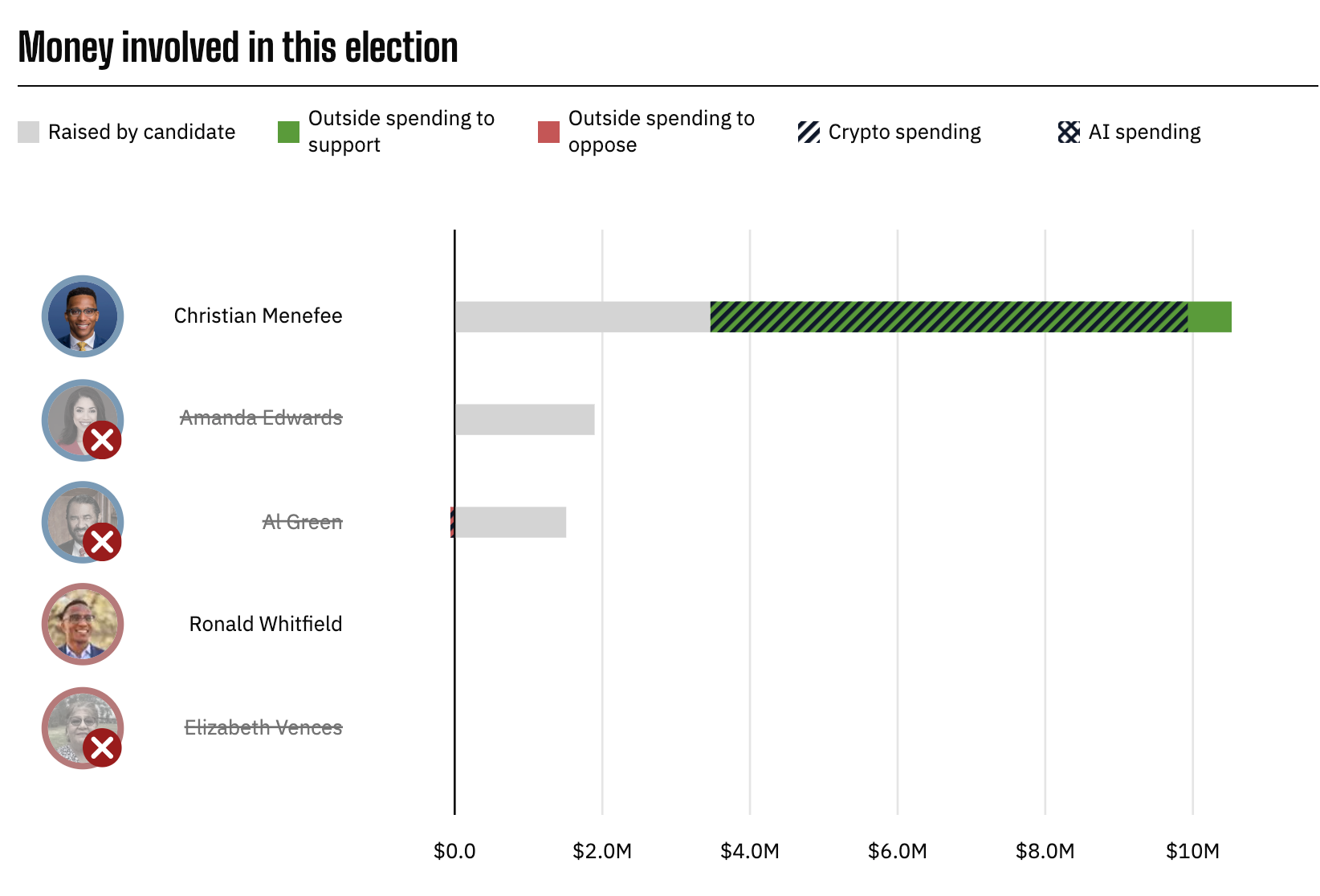
The network had also claimed a “6–0 sweep” in the May 19 primaries across Alabama, Kentucky, and Georgia, although this was something of a characteristic FairShake overstatement. In Alabama’s Republican Senate primary, the network’s record-breaking $12.2 million for Barry Moore — the most any crypto- or AI-focused network has spent on a single candidate thus far — couldn’t secure an outright win. Moore fell short of 50% support and faced a runoff, though he did eventually win on June 16. Another combined $680,000 came from the Cantor Fitzgerald-funded and Tether-linked Fellowship pro-crypto PAC and the Andreessen- and OpenAI-backed Leading the Future AI PAC network.
In the Kentucky Senate primary, the FairShake network’s $7.2 million to back Republican Andy Barr likely had less to do with his victory than President Trump’s intervention. With promises of an ambassador nomination, Trump successfully helped to clear the field when he pressured Barr’s toughest opponent, Nate Morris, to drop out and endorse Barr.e Barr, who currently sits on the House Financial Services Committee and chairs its Subcommittee on Financial Institutions and Monetary Policy, has been a valuable ally to the cryptocurrency industry.
FairShake supported four Georgia House candidates with varying levels of investment: $4.2 million for Democrat Jasmine Clark in District 13, $709,000 for Republican Houston Gaines in District 10, $455,000 for Republican Clayton Fuller in District 14, and $431,000 for Republican James Kingston in District 1. All four won their primaries, though Fuller — who had won the District 14 special election just three months earlier — was already a shoo-in. In the three races backing Republicans, the Leading the Future AI-focused PAC network joined FairShake’s efforts. The two networks appear together often, which is not tremendously surprising given they share significant backing from Andreessen Horowitz, and longtime FairShake spokesman Josh Vlasto is a strategist for Leading the Future.
June primaries
June brought the California primaries, where crypto spent across nine House races, exclusively supporting Democrats. All progressed to the general election. Abundant Future, another Chris Larsen-backed PAC, spent $888,000 to oppose socialist-leaning Saikat Chakrabarti in District 11, and he was defeated in the non-partisan primary by the more establishment Democrats Scott Wiener and Connie Chan.
In South Carolina, Fellowship PAC-supported incumbent Republican Senator Lindsey Graham and FairShake-supported incumbent Republican William Timmons in District 4 both defeated their primary challengers.
In Oklahoma, just over $2 million — roughly split between crypto and AI PACs — backed Kevin Hern in the Senate race to fill the seat vacated by Markwayne Mullin. Hern likely didn’t need the boost, handily winning the primary, but his authorship of the industry-friendly Clarity Act and other pro-crypto moves while in the House was nevertheless warmly rewarded by the industry.
In Congress
The Clarity Act cryptocurrency market structure bill failed to pass by its predicted September 2025 deadline [I91], and its end-of-2025 deadline [I97], and its April 2026 deadline [I103]. At the beginning of the year, we began hearing worried estimates of how soon the bill would need to pass before all hope was lost of it getting through under this Congress. In March, Senator Bernie Moreno (R-OH) warned, “If we don’t get the Clarity Act passed by May, digital asset legislation will not pass for the foreseeable future.” [I103] Well, here we are, sailing through June and toward the new deadline of July 4, set by Patrick Witt of the President’s Council of Advisors for Digital Assets based apparently on the fact that he believes it would be “a tremendous birthday present for America”. (Senator Kirsten Gillibrand (D-NY) has provided a separate estimate of early August).9
There was a flurry of excitement in the crypto industry in mid-May when the bill finally emerged out of Senate Banking after months of negotiations, despite objections from Democrats and banking lobbyists. The vote passed 15–9 with the support of all Committee Republicans and two Democrats: Ruben Gallego (AZ) and Angela Alsobrooks (MD). Both Democrats voted in favor of the bill, despite previously pledging not to unless ethics language was added to limit President Trump’s crypto involvement (it wasn’t). Both have since suggested they now might not cast their final votes for the bill without such ethics language, though they have not shown their word to be very good thus far.10
Crypto is pushing hard to rush the bill through before midterms potentially change the balance of power in Congress, and Coinbase’s Stand With Crypto advocacy group penned a letter on June 7 on behalf of dozens of crypto firms pressing Senators to bring the bill to a floor vote.11 Pressure is also coming from within the government, with Treasury Secretary Scott Bessent also urging Senators to support the bill.12 But despite getting past the Senate Banking hurdle, the bill doesn’t seem all that much closer to being signed into law — good news, in my view, for an industry-written bill devoid of consumer protections and officeholder ethics requirements, largely aimed at deregulating the crypto sector.
Conflict-of-interest, corruption, and self-dealing concerns continue to pile up around the President, such as his controversial settlement with himself in a lawsuit against the IRS — a resolution that prevents the IRS from auditing Trump’s or his family member’s tax returns and (as yet unsuccessfully) attempts to establish a $1.8 billion “Anti-Weaponization Fund”.13 As the pile of corrupt deals and crypto-related quid pro quos grows larger, pressure mounts on Congress to add anti-corruption language to the bill, against the wishes of Republicans who are perfectly willing to battle over such provisions behind closed doors but would rather not be seen publicly voting to enable Trump’s self-dealing to continue. There’s also been a growing rift between Trump and Senate Republicans, particularly during recent budget reconciliation negotiations where some Republican Senators supported amendments to block Trump’s ballroom project or his “anti-weaponization” fund. And as more states hold their primaries each week, we may see more Republican incumbents like Bill Cassidy and John Cornyn lose their primaries and, along with their chances of re-election, their imperative to vote in lockstep with Trump’s agenda.
There’s also the scheduling issue. Crypto reporter Eleanor Terrett pointed out in her recent newsletter that there simply isn’t enough time for the bill to pass by Witt’s July 4 target. The Senate is only in session for five more days between now and then. As Terrett explains, “To make that timeline work, the Senate would first need to merge the Banking and Agriculture Committee texts, secure the 60 votes needed to invoke cloture on the motion to proceed, achieve cloture on a manager’s amendment, adopt that amendment, and pass the legislation. The House, which is out this week, would then need to approve the Senate’s changes and pass the bill again before it could be sent to President Trump’s desk for signature.” And all of that would need to happen with multiple contentious negotiations left to resolve.14
The Senators hoping the bill could pass the full Senate by the August recess have another twenty days in session to avail themselves of, but those days are shared with other pressing legislative priorities, such as renewing the lapsed Section 702 of the Foreign Intelligence Surveillance Act15 — which Trump has demanded Senate Republicans link to his similarly controversial SAVE Act voter suppression bill. And if the August recess arrives before the bill passes, its prospects grow far more dire.
In regulators
CFTC
The New York Times has published an extensive investigation into the Commodity Futures Trading Commission’s handling of Polymarket, Crypto.com, and Gemini — three companies with extensive ties to President Trump and his family. 1789 Capital, a venture firm partly owned by Donald Trump Jr., made an eight-figure investment into Polymarket last year, with Trump Jr. joining its advisory board.16 Crypto.com has been a Trump campaign mega-donor, and has a long list of business partnerships with President Trump’s Trump Media & Technology Group, the parent company of Truth Social. Gemini and its founders, the Winklevoss twins, are also major Trump donors, and are investors in the Trump sons’ American Bitcoin firm. Both Polymarket and Crypto.com were prominent sponsors of Trump’s recent UFC event at the White House.
According to the Times, when senior officials at the CFTC raised concerns about fairness, fraud protections, and adequate agency review, then-acting CFTC Chair Caroline Pham and her senior counsel, Brigitte Weyls, stepped in to clear the hurdles from the crypto companies’ paths. At least five officials who raised concerns like these, or enforced laws pertaining to crypto, were placed under investigation and put on leave. According to the Times, “current and former agency staffers said in interviews that the commission’s work force took away a clear message: Don’t cause trouble for those industries.”
Pham is no longer at the CFTC, having stepped down shortly after her replacement was appointed to immediately take a job at MoonPay [I99], a Trump-linked company that handles the cash-to-crypto conversion for Polymarket. Weyls also resigned from the CFTC several months later to take a job with Gemini Titan, the prediction market arm of Gemini whose application was prematurely approved after an abnormal intervention by Weyls herself. But although Pham and Weyls are no longer at the CFTC to fast-track prediction market applications, the industry still has a strong ally in the agency’s new and only Commissioner, Mike Selig. Under Selig’s direction, the CFTC has sued several states that have attempted to enforce gambling regulations against prediction market firms [I104, 105]. And although there have been several high-profile allegations of insider trading on Polymarket and other prediction market platforms [I102, 105], Selig’s CFTC has gone after the traders but not the companies, which have a responsibility to police traders and, in Polymarket’s case, prohibit US traders entirely. (The widespread use of Polymarket by Americans is an open secret, and a recent study estimates that about a third of trading on the platform comes from US customers.17)
The CFTC has also approved Kalshi and Coinbase to offer crypto perpetual futures (often abbreviated to “perps”), which are a type of derivative that never expires. A standard futures contract is a bet on what an asset will be worth on a specific date. A perp removes the deadline, allowing traders to bet on a token’s price indefinitely without ever owning the token itself. This is an invention largely limited to crypto, which has no dividends or economic fundamentals to anchor its value the way a stock or bond does. The biggest draw, however, is leverage: perps are typically traded with borrowed money at ratios that offshore venues have pushed as high as several hundred times a trader’s actual stake, which means a small fluctuation in the wrong direction can wipe out the position entirely.
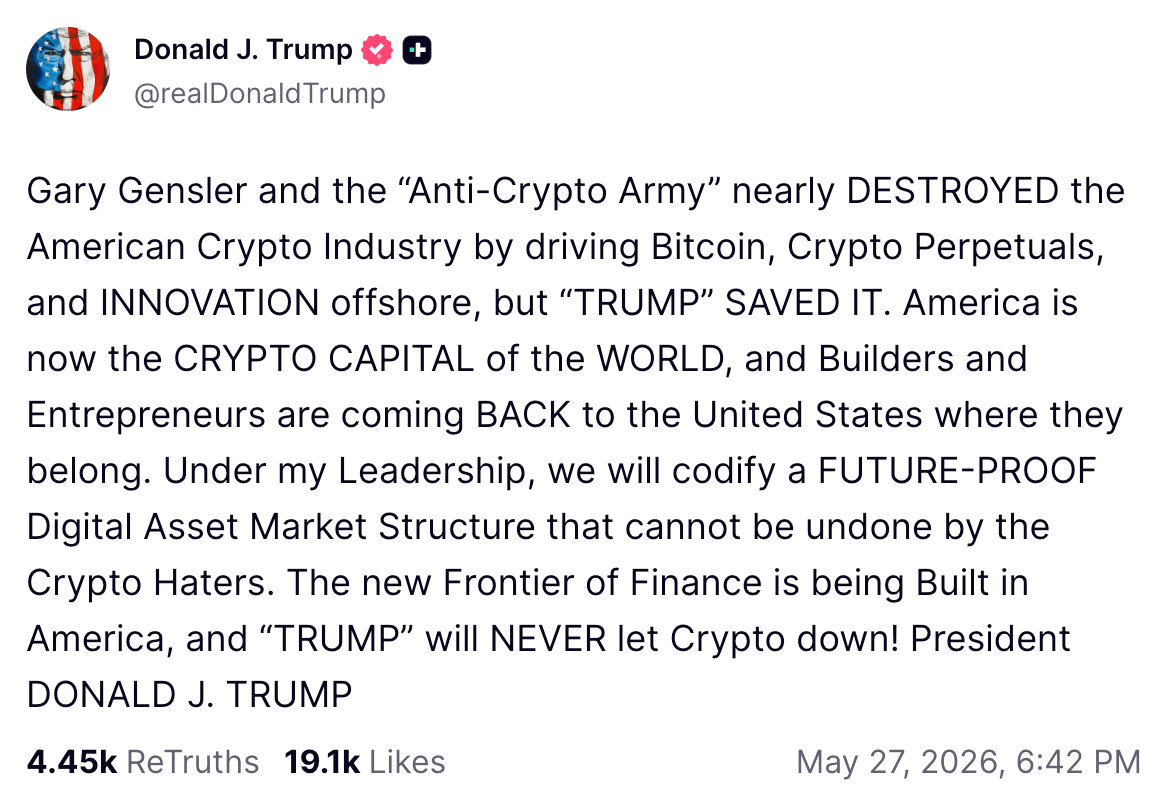
The combination of indefinite duration, high leverage, and no underlying asset is largely why US regulators deemed the instruments too risky for retail traders, up until now. The approval followed a social media post from President Trump that claimed that regulators under previous administrations had “nearly destroyed the American crypto industry” by prohibiting crypto perps trading.
The approvals quickly met pushback from traditional finance. Terry Duffy, the outgoing CEO of the CME Group futures trading giant, announced that his firm will be suing the CFTC over the approval.18 At a recent conference, Duffy expressed “grave concerns” with the instrument, describing perps as “a disaster waiting to happen” and comparing them to the expansion of speculative housing-related instruments that preceded the 2008 financial crisis. He also said he had concerns about making such contracts available to retail traders: “I don’t like to see people that don’t understand products to potentially get blown out of a contract that they shouldn’t be in the first place.”19
SEC
After issuing guidance in January that boiled down to “a stock doesn’t magically stop being a security just because you put it on the blockchain” [I100], the SEC looks like it may be about to reverse course on that stance, delivering a massive win to the crypto industry and potentially massive losses to retail investors. The industry has already been testing such offerings, mostly overseas — recently resulting in a multi-platform SNAFU where traders who participated in presales of tokenized SpaceX stock ended up emptyhanded.20 But now, the SEC appears to be on the cusp of allowing crypto firms to sell tokenized stocks to US buyers through an “innovation exemption” that would mean firms would not need to comply with all the usual SEC disclosures and investor protection rules. Several massive crypto firms, including Coinbase, Robinhood, and Kraken, are eager to sell such assets to US retail customers.21
In crime
The Second Circuit of Appeals has upheld Sam Bankman-Fried’s conviction and 25-year sentence, as I covered in more detail in a [noted] post last week.
 Molly White
This leaves a presidential pardon as one of Bankman-Fried’s only realistic paths to freedom, and with little social, political, or financial capital left available to him, his chances of that seem limited as well. Still, two of the Senate’s top crypto industry advocates, Cynthia Lummis (R-WY) and Ruben Gallego (D-AZ), seem concerned enough that it could be a possibility that they’ve introduced a resolution to “express[] the sense of the Senate that under no circumstances should Samuel Bankman-Fried receive executive clemency, including a pardon or commutation”.22 Should it pass, it would not be binding on the President.
Another former FTX executive also faced some disappointment in court this month. Judge George Daniels, the federal judge overseeing a campaign finance case against Michelle Bond, wife of jailed FTX executive Ryan Salame, declined to dismiss the case after over a year of arguments that prosecutors had promised to drop their case against her if Salame entered a guilty plea for his criminal charges related to FTX [I66, 67]. Salame indeed pleaded guilty in September 2023, and is serving a seven-year sentence [Salame, I69]. Daniels concluded that the evidence “undisputably indicates that the Government did not promise to not prosecute Bond in exchange for Salame’s guilty plea” and that “no reasonable party would believe that Salame’s guilty plea guaranteed immunity from prosecution for Bond.”23 Bond is facing allegations that she entered into a “sham consulting agreement” with FTX for which she was paid $400,000, which she then used to illegally finance her unsuccessful 2022 New York Congressional campaign.24
Another convicted crypto fraudster, Celsius founder Alex Mashinsky, has filed a pro se motion to vacate his 12-year prison sentence.25 His argument rests on the claim that he received ineffective counsel from Mukasey & Young, who he says prioritized a fast resolution to the case because they were under financial stress. He also claims that “Counsel’s financial desperation is most evident by his unethical and secret effort to secure a conflicting client, FTX’s Sam Bankman-Fried (SBF) without informing [Mashinsky].” (A Curcio hearing was held in February 2024 at the request of the prosecution, and Mashinsky confirmed he was aware of the potential conflict and waived it. [I51])
Outside the US
Reform UK leader Nigel Farage, under scrutiny for accepting millions of pounds in campaign contributions from Tether-linked crypto billionaire Christopher Harborne [I98, 102, 105], appears to be hoping to shift the focus of the controversy. He’s claimed without evidence that The Guardian’s reporting on Harborne’s £5 million gift to Farage in 2024, shortly before Farage reversed his decision not to run for office, was based on a Russian “hack-and-leak” operation. Farage is not believed to have reported his claims that his phone and bank accounts were hacked to the police, although opposition parties have called for him to provide evidence of the hack to UK authorities. The Labour party subsequently sent a letter to national police and intelligence authorities stating, “If Reform UK have not reported this to you, please treat this letter as a formal report of what appears, on the basis of media reports, to be an allegation of a serious crime.”26
Ciaran Martin, former head of the UK intelligence agency’s National Cyber Security Centre, told The Guardian, “An aspiring prime minister has essentially claimed that Russia has launched an unprecedentedly aggressive intervention — a malicious intervention — in British politics, and he’s not produced a shred of evidence to support that claim. ... It is a very, very serious thing to allege. It would be a national security issue. If it is true, the government should be in emergency session in COBR right now considering their response to the most serious Russian intervention in internal British affairs for years.” Martin added that, based on Farage’s public statements, “this is an entirely unsubstantiated claim and one without any merit.”27
The Web3 is Going Just Great recap
There were sixteen entries between May 8 and June 18. $79.42 million was added to the grift counter.
- Aztec Connect hacked for a second time in less than a week [link]
- Pudgy Penguins shuts down Pudgy Party NFT game after losing millions in less than ten months [link]
- Deprecated project Aztec Connect exploited for $2.1 million [link]
- Raydium users lose $1.34 million after legacy smart contract exploited [link]
- Humanity Protocol loses $36 million to employee laptop compromise [link]
- Thief steals remaining 7,200 unsold The Kiss NFTs in digital museum heist [link]
- Gravity Bridge drained of $5.4 million [link]
- DxSale exploited for $7.3 million [link]
- SquidRouterModule, unrelated to Squid Router, exploited for $3.2 million [link]
- Polymarket loses $700,000 to private key compromise [link]
- RetoSwap users lose $2.7 million to Haveno vulnerability [link]
- Largest North American bitcoin ATM operator, Bitcoin Depot, files for bankruptcy [link]
- Verus bridge hacked for $11.6 million, $8.5 million returned [link]
- THORchain exploited for $10.8 million [link]
- Transit Finance hacked for $1.88 million [link]
- TAC bridge exploited for $2.8 million [link]
Worth a read
As a part of their “Coin Laundry” investigative series, ICIJ journalist Spencer Woodman outlines how the move to issue modified banking licenses to crypto firms minimizes federal oversight and reduces the ability for state regulators to handle consumer complaints. State authorities have largely been on the forefront of consumer protection in the crypto sector as federal regulators abdicate their reponsibility.
I’ve covered in past issues of this newsletter how the CFTC and Justice Department are going to bat for prediction markets against state regulators seeking to enforce gambling laws. The CFTC intervened in the Crypto.com v. Nevada case, and has subsequently sued multiple states who have either tried to enforce gambling laws against these platforms, or look likely to. This is particularly troubling given the Trump family’s close ties to the prediction market sector, as I described in the regulatory section of this issue. Now we’re seeing similar intervention on behalf of AI companies, namely xAI, a company owned by Elon Musk — the largest donor to Trump’s 2024 campaign.
In the news
I’m quoted in Greg Ip’s recent piece about stablecoins, where he opines that stablecoins are similar to private money issued in the 19th century during the free banking era. The proliferation of stablecoins, he writes, bears “the risk that this could lead to financial crisis, much like some past experiments with private money.”
I went on Posting Through It, hosted by Jared Holt and Michael Edison Hayden, to talk about the cryptocurrency industry’s massive spending on the midterm elections, and how the President is getting rich off crypto.
I joined Tonantzin Carmona on Dave Troy’s podcast to discuss where crypto stands after more than a year under the Trump administration, where it’s headed, and what the crypto industry is doing to try to shape the future of crypto to their agenda.
Tech Influence Watch earned a shoutout in The Verge’s Regulator newsletter, and in Gothamist, where I spoke about the proxy war between AI super PACs for a piece titled “How Big AI money is shaping the marquee Manhattan congressional primary”.
That's all for now, folks. Until next time,
– Molly White
Have information? Send tips (no PR) to molly0xfff.07 on Signal or molly@mollywhite.net (PGP).
I have disclosures for my work and writing pertaining to cryptocurrencies.
Footnotes
Remember when companies used to shove blockchain-related terms into their names to raise investor interest? Now I guess blockchain companies are doing the same with AI. ↩
The company cites two different values for the same tokens on the same date within this filing: $703.4 million in its discussion of liquidity, and $706.4 million on its balance sheet and in the accompanying notes. It’s a fairly minor discrepancy and likely an honest mistake, but you’d think a company that settled SEC charges related to its financial reports in 202430 might be a little more cautious. ↩
The Politico poll was run in collaboration with a group called Public First, which is a UK-based research organization and not the identically-named pro-AI PAC and dark money network. ↩
OpenAI has insisted it has no involvement with Leading the Future and has not funded it. OpenAI president and co-founder Greg Brockman, and his wife Anna, have contributed $25 million to the super PAC — making them its second-largest backers behind Andreessen Horowitz. ↩
On May 1, President Trump posted to Truth social that he had asked Morris to “step aside” from the Senate race in exchange for a nomination to become the US Ambassador to Colombia.28 Minutes later, the president endorsed Barr, and Morris reposted the endorsement, writing “I’m incredibly proud to join President Trump in endorsing Andy Barr for Senate.”29 ↩
References
“Under the Trump crypto playbook, the family always wins. Investors don’t”, Reuters. ↩
Form 8-K filed by AI Financial Corporation on June 10, 2026. ↩
“How Crypto Firms Will Own the Octagon at Trump's White House UFC Event”, Decrypt. ↩
“Poll: The midterms' new big players are pushing agendas that voters don’t fully support”, Politico. ↩
“Tether executive warns the 2026 midterms could have 'seismic impact' on crypto industry”, CoinDesk. ↩
“How Big AI money is shaping the marquee Manhattan congressional primary”, Gothamist. ↩
“White House targets July 4 for Clarity Act passage, says crypto adviser Patrick Witt”, CoinDesk. ↩
“Democrats Split on Clarity Act as Crypto Bill Passes Key Senate Committee Vote”, Decrypt. ↩
“Bessent backs summer push for Clarity Act, says bitcoin reserve moving at ‘deliberate speed’”, The Block. ↩
“Judge extends block on Trump’s $1.8bn ‘anti-weaponization’ fund”, The Guardian. ↩
“Why the Math Doesn't Work for a July 4 Clarity Act”, Crypto in America. ↩
“Scoop: Donald Trump Jr.'s VC firm bets on Polymarket”, Axios. ↩
“Americans Are Trading Billions of Dollars on Polymarket’s Banned Offshore Platform”, Wired. ↩
“CME CEO Terrence Duffy says the exchange operator will sue CFTC over perpetual futures”, CNBC. ↩
“CME CEO Duffy says new perpetual futures could be ‘disaster waiting to happen’”, The Block. ↩
“SpaceX IPO scramble reveals difference between tokenizing a stock and getting one”, CoinDesk. ↩
“US SEC poised to allow stock token trading in potential market shakeup”, Reuters. ↩
Proposed Senate resolution opposing a pardon of Sam Bankman-Fried. ↩
Memorandum decision and order filed on June 17, 2026. Document #111 in US v. Bond. ↩
Indictment filed on August 19, 2024. Document #1 in US v. Bond. ↩
Motion to vacate filed on May 28, 2026. Document #189 in US v. Mashinsky. ↩
“Labour reports Farage’s alleged Russian phone hack to police”, BBC. ↩
“Nigel Farage’s Russian hack claim ‘without any merit’, former NCSC chief says”, The Guardian. ↩
Truth Social post by Donald Trump. ↩


