Issue 108 – In a word, applesauce
Firms close up shop amid a continued crypto winter, a Trump venture ditches its crypto plans, and the Clarity Act fails to reach a vote before August recess



The crypto industry is having an increasingly rough time as prices remain depressed. Bitcoin is hovering around its lowest price since autumn 2024, well below the “Trump pump” prices spurred by traders who hoped his inauguration would bring about a crypto renaissance. Robinhood reported crypto trading revenue down 38% and trading volumes down 35% year-over-year.1 Coinbase reported a net loss of $359 million and has stopped using trading volume as a key metric, claiming it “no longer reflects the breadth of our business”. This is, I’m sure, entirely unrelated to the fact that their trading volume is down 38%/48% over the past three/six months.2 At least three crypto exchanges — AscendEx,3 BitMEX,4 and BitMart5 — announced in July they would be shutting down. Other darlings from the web3 bubble have also announced they’re closing up shop recently: the Proof of Attendance Protocol [W3IGG], the Step App “move-to-earn” product [W3IGG], and MVMT Labs [W3IGG]. Poolin, a bitcoin mining firm that once accounted for a fifth of the global hashrate, has filed for bankruptcy [W3IGG].
The president’s own Trump Media & Technology Group posted a $238 million loss. While losses are routine for the company, this quarter’s came alongside announcements that the firm would be unwinding multiple crypto-related partnerships with Crypto.com.
And despite many, many promises from pro-crypto senators, the Clarity Act didn’t make it to a vote before the August recess. A cloture vote is scheduled for shortly after the Senate reconvenes, though it now looks less like a serious attempt to pass the bill and more like an effort to provide crypto industry super PACs with a list of opposition spending targets.
Citation Needed is an independent publication, entirely supported by readers like you. Consider signing up for a free or pay-what-you-want subscription — it really helps me to keep doing this work.
In Congress
Clarity Act
I was beginning to think that even as Senators were boarding the planes to their respective states for the August recess, they would still be promising that they could squeak in a vote on the Clarity Act cryptocurrency market structure bill. “We have the time to get it done,” said Senator Tim Scott (R-SC) in a Fox Business interview on the Wednesday of last week, the Senate’s last week in session.6 But Senate Majority Leader John Thune (R-SD), who as recently as that Monday was still pledging a pre-recess vote, finally confirmed that it won’t be happening.7
Thune has, however, scheduled a motion for cloture for the Senate’s second day back in session. This preliminary vote can be taken one of two ways: either Thune genuinely believes that negotiators can make enough progress on presidential ethics, bank deposit flight, illicit finance, and other contentious provisions in order to convince seven Democrats to sign on, or he is simply pushing Senators to publicly state a position on the bill as midterms approach and the cryptocurrency industry decides how to direct its $250 million war chest.
If I was a betting woman, I would guess the latter is more likely. The bill is in an even worse place than it was when I wrote about it last issue [I107]. Then, the White House had agreed to proposed ethics language, and Democrats had only just seen the draft language and begun to express concerns. Since then, Senators Tillis (R-NC) and Gallego (D-AZ) drafted new ethics language to present to the White House — a do-over after the previous version, crafted with little Democratic input, failed to win a single Democratic pledge. The White House has yet to sign off on the new language, and it’s not clear they will — allowing enforcement by attorneys general was reportedly a hard line for Trump.8 And while Trump’s approval is not required for the bill to advance, it leaves the risk of a veto looming. A component of the new agreement would require the president to divest from crypto-related businesses — though according to Bloomberg, this could allow him to defer millions in taxes on his crypto gains. The deal also reportedly allows state attorneys general to enforce ethics measures, a key Democratic demand, but only if the Justice Department declines to do so.9 The full text hasn’t been released yet, but this model concerns me: a Trump-controlled DOJ could stall indefinitely to block state enforcement. Even if the language allows states to act when the DOJ fails to open a case within a certain window, the DOJ could open a weak enforcement action as a stalling tactic.
Two Republican senators, neither of whom are up for re-election, have also publicly committed to voting against the bill, citing concerns about deposit flight from community banks. Josh Hawley (R-MO) pledged to side with the “agriculture folks, local community people” who are “blowing [him] up over” the bill. “Farmers and ranchers, in particular, are very, very concerned that deposit flight in small towns could absolutely kill their ability to get ag loans,” he said.10 Jerry Moran (R-KS) also committed to vote no.11 Other Republicans have expressed reservations but stopped short of pledging to vote against the bill [I107].
Meanwhile, the crypto super PACs are itching to get a vote on record so they can direct their spending accordingly. “That’s the whole reason Thune has to have a vote ... You have to hold it on the record for the PAC funding side,” a crypto executive told Semafor late last month.8 Democrats had reportedly threatened to delay other important agenda items to avoid a vote before the midterms, suggesting that Democrats who’ve previously allied with the industry (or who want to keep that door open) are anxious about being forced to take a public position before November.
Other Senate business
As the Clarity Act flounders, other Senators are taking different approaches to tackling Trump’s crypto corruption. Senate Minority Leader Chuck Schumer (D-NY) has introduced legislation that would create an independent anti-corruption bureau intended to address corruption by Trump and future presidents. The bill would allow state attorneys general and private plaintiffs to sue to recover ill-gotten funds, and contains funding and appointments provisions designed to insulate the agency from presidential control.12
Senators Warren (D-MA) and Blumenthal (D-CT) have called for an SEC investigation into the president’s $TRUMP memecoin, following a July report by the Nansen crypto analytics firm that found investors lost $3.8 billion on the token — the same token that netted Trump $636 million, according to his recent financial disclosure.13 “We are concerned that President Trump’s memecoin scheme may constitute an illegal scam, such as a ‘rug pull,’” the Senators wrote. 14 The letter is unlikely to prompt action from the Trump loyalist–led SEC, but it may have served as leverage on senators weighing their support for the Clarity Act, and could help lay the groundwork for future legislative action.
Two days later, Warren turned her attention to Commerce Secretary Howard Lutnick, questioning his decision to allow the United Arab Emirates to purchase powerful AI chips [I83, 87, 93, 94, 95]. That decision, she wrote, “comes after UAE entities tied to the nation’s top intelligence official reportedly invested half a billion dollars and took board seats in the Trump family crypto venture, World Liberty Financial (WLF). ... The Department’s actions raise significant questions about the potential influence the President’s cryptocurrency business interests may be having on the agency’s operations and our national security.”15
In elections and political influence
A new poll from Lake Research Partners and Chesapeake Beach Consulting has found that two thirds of voters believe the cryptocurrency industry has too much influence in Washington, and largely reject the argument that “cryptocurrency is a promising innovation that is revolutionizing finance” that shouldn’t be regulated like traditional finance, and instead agree with concerns about scams and fraud or risk to the broader economy. The poll also featured a few other questions about concerns about cryptocurrency legislation, although in my view those questions were tailored to elicit negative responses.16a
The crypto super PACs’ $2 million bet on Michigan’s District 13 failed to pay off last week. Incumbent Shri Thanedar — a reliable industry ally who’d co-sponsored the House’s version of the Clarity Act [I89] — lost his primary to Donavan McKinney, a Democratic Socialist who successfully painted him as the establishment and corporate-backed option.
McKinney built on the wave of support for more progressive candidates in his state that also saw Democratic Senate candidate Abdul El-Sayed win over his moderate primary opponent, Haley Stevens. Thanedar had also faced scrutiny for a number of separate issues — not least his choice to invest millions of campaign funds into cryptocurrency, which ended with his campaign reporting a negative balance. (Most of the invested funds had started as personal loans from Thanedar, whose entrepreneurial background in the chemistry sector made him a multimillionaire.) The Fairshake network had backed Thanedar’s 2024 re-election with $1 million, which bought them a strong ally. This time, double the spending couldn’t do the job.
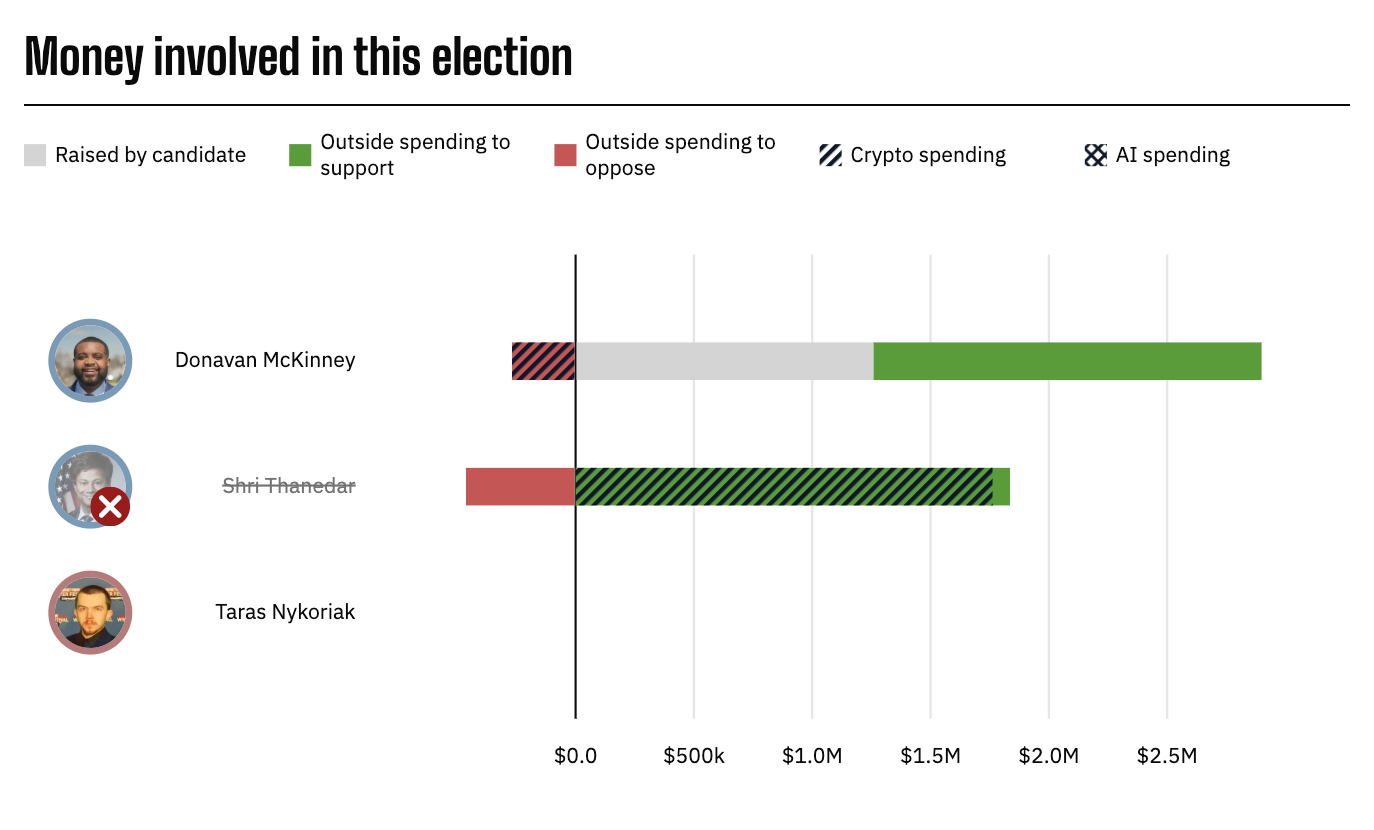
It was a bruising loss for the crypto PACs, and a more revealing result than their overall win rate in these primaries, which mostly reflects spending on candidates who were already likely to win. The races — across Kansas, Michigan, Missouri, Tennessee, Virginia, and Washington — didn’t draw anything close to the eight-figure spending like we’ve seen earlier this season in Alabama and Illinois, but the industry still showed up with $3.4 million across three Michigan races, $828,000 across four in Washington, and $150,000 on one Virginia primary.
In most races, the spending followed the super PACs’ “back the winners” strategy, where they back candidates (typically incumbents) who are already highly favored to win their elections, and for whom the support does not likely make much difference to the outcome of the race. This accomplishes two goals: it rewards crypto-friendly candidates and makes them more likely to continue supporting the industry’s agenda in Congress, and it allows the PACs to inflate their win percentage when they later claim credit for Congressional victories. Even if the super PAC money makes no ultimate difference to a shoo-in race, the PACs will later count the victory; for example, in 2024, Fairshake boasted of its “91% win rate”, claiming in those figures their primary election support for candidates like Jim Banks (R-IN) or Ritchie Torres (D-NY) who both ran uncontested and later participated in general elections that were predicted to safely go to their party. That same year, 32 of the 39 candidates endorsed by the Coinbase-backed advocacy group Stand With Crypto had been assigned a 75% or more chance of winning their races by The Hill leading up to the general election [I70].
That strategy was reflected in the PACs’ support in these recent races. Fairshake shelled out in support of candidates across Michigan’s District 4 and Washington’s Districts 1, 8, and 10, all of whom are incumbents and are not facing particularly strenuous challenges in the general election. The Cantor Fitzgerald-backed Fellowship PAC tossed $150,000 to Democratic Senate incumbent Mark Warner in Virginia, who is also likely to win re-election. And while the Fairshake-supported Amanda McKinney in Washington’s District 4 is not an incumbent, she’s the Trump-endorsed replacement for the retiring Dan Newhouse in a district that’s likely to go Republican.
That left two races where the PACs spent on candidates who are not shoo-ins to win their races, both in Michigan. One was Thanedar’s race; the other was in the Senate. The First Principles Digital PAC — backed by the Winklevosses and created to pursue a more explicitly MAGA agenda than the Fairshake network — shelled out $810,000 in its first expenditure so far this cycle to support Republican Mike Rogers in his Senate primary, where he ran unopposed. Though Rogers certainly wasn’t in any danger of losing the primary, he will face a tough battle in the general against progressive Abdul El-Sayed.
Trump business interests
Trump Media & Technology Group
The president’s Trump Media & Technology Group (TMTG), parent company of his Truth Social platform, has backed out of its deals with cryptocurrency exchange Crypto.com. The Singapore-based company has contributed $36 million to Trump’s various super PACs since December 2024, when it first donated to his inaugural fund. In March 2025, TMTG announced its first partnership with Crypto.com: a plan to launch “made in America” exchange-traded products incorporating both crypto and non-crypto assets [I80]. Just three days later, Crypto.com announced that the Securities and Exchange Commission had dropped its investigation into the company [I81]. In August 2025, the two companies announced a joint venture called Trump Media Group CRO Strategy Inc., a treasury company to hold Crypto.com’s CRO token [I91]. And in October, they announced yet another partnership, in which Truth Social would offer prediction markets via a Crypto.com integration.17
All those plans are now falling apart. In May of this year, TMTG’s investment partner, Yorkville America, withdrew its SEC applications to list several planned crypto asset ETFs that would have been serviced by Crypto.com.18 Last week, Crypto.com and TMTG announced they would be canceling their plan to launch the CRO treasury company, citing “prevailing market conditions, and shifting business and stakeholder priorities”. The same press release also formally confirmed that Crypto.com would no longer be a part of TMTG’s ETF plans.19 Separately, the companies announced that Crypto.com would no longer be integrating with Truth Social to provide built-in prediction markets, though they claimed a marketing agreement would remain in which Truth Social would market Crypto.com’s existing prediction markets to users. TMTG’s interim CEO, Kevin McGurn, explained: “Our strategic focus is to drive revenue across Truth Social, continue to build our global media business, and close the merger with TAE” — referring to a planned merger with the nuclear fusion company TAE Technologies.20
TMTG’s second-quarter report followed shortly after, revealing a net loss of more than $238 million, including $116.7 million in losses on their digital asset holdings (bitcoin and CRO) and another $73.7 million in losses on equity securities. The company posted only $1.7 million in revenue.21 Crypto.com may also be struggling: crypto media outlet Protos raised questions about a “crisis brewing” at Crypto.com, pointing to an executive exodus, slashed credit card rewards,b and a 70% downturn in the price of CRO over the last year.22
Aqua 1 Foundation
The New York Times has published a longform investigation into Bobby Zhou, a co-founder of the mysterious UAE-based Aqua 1 Foundation that purchased $100 million in WLFI in June 2025 [I87, 88]. The deal drew immediate scrutiny, with journalist Jacob Silverman questioning whether the company even existed at all. Now, the Times has published a history of Zhou’s money laundering allegations and financial troubles, casting doubt on Zhou’s sudden ability to access $100 million — and World Liberty’s willingness to accept it.
In prediction markets
Former New York Representative George Santos has settled a CFTC lawsuit by agreeing to pay $35,000 after the agency sued him for manipulating Kalshi markets tied to his own attendance at the State of the Union address in February. According to the CFTC, Santos placed bets that he would attend, then posted publicly about his outfit plans and travel to Washington, causing contract prices to rise before he cashed out. He then took a “no” position and ultimately did not attend, allegedly pocketing more than $17,500.23
The CFTC has also issued a series of warnings to prediction markets. On July 24, the agency warned platforms against mass self-certification that similar contracts comply with commodities laws, rather than individually certifying each specific market.24 And on August 7, the agency seemed annoyed that some prediction markets aren’t bothering to disguise their obvious gambling as financial instruments, writing they had received reports of products “marketed not in nominal or percentage terms that reflect market pricing, but in the ‘American odds’ format used by casino gambling bookmakers”.25 The CFTC cited a study from the British Behavioural Insights Team that found that gamblers presented with the American-style (or moneyline) odds formatting were significantly more likely both to choose riskier bets and to overestimate their likelihood of winning.26
A group of senators have called for the CFTC to stop prediction market platforms from offering wildfire-related markets,27 citing concerns from the US Forest Service that “t[ying] financial gain to wildfire outcomes risk[s] encouraging misuse, including arson”.28 I highlighted this issue all the way back in a January 2025 issue titled “Degen volunteer fire brigade”, noting the obvious and serious concern that someone betting “yes” on a fire spreading to a specific location might be incentivized to light one there. (I also joked that perhaps enough “no” bets could produce an impromptu “volunteer fire brigade made up of crypto degens hoping to protect the outcome of their bet.”)
State-level regulation
Attorneys general from 44 states have signed a letter to the CFTC, submitted during a public comment period on proposed rulemaking for prediction markets. The rulemaking has primarily focused on sports-related markets, which the state AGs argue are gambling and should be regulated at the state level. The AGs describe the CFTC’s proposal as “well beyond [the CFTC’s] statutory authority” that would “take[] a sledgehammer to the States’ historic power, giving the CFTC a virtual veto over state policies”. The only state AGs who didn’t sign on to the letter were those of Florida, Georgia, New Hampshire, Missouri, and Texas.29
Prediction markets continue to see mixed outcomes amid a deluge of state lawsuits and preemptive challenges to states’ regulatory authority. In Minnesota, a federal judge has temporarily paused a statewide ban that would have made it a felony for companies like Polymarket and Kalshi to continue operating there — a win for those companies.30 The CFTC also sued Minnesota over the law, and had indicated it would go to the Eighth Circuit if the judge declined to enjoin the state from enforcement.31
But in New York’s Southern District, a judge declined the CFTC’s request for a temporary restraining order to halt a state lawsuit against Kalshi, finding that the CFTC had not shown “a high likelihood of success on the merits or a likelihood of irreparable harm.”32 And in Michigan, a judge has denied a Coinbase request for a preliminary injunction to block regulators from enforcing state gambling laws, writing that “Coinbase’s averments are, in a word, applesauce.”c She rejected the company’s argument that the Commodity Exchange Act preempts all state laws addressing swaps, and wrote, “it is not impossible for Coinbase to comply with the [Michigan Lawful Sports Betting Act] simply because it is costly and challenging.”33c
In regulators
The SEC has agreed to release additional documents and pay $150,000 in attorneys’ fees to settle a Freedom of Information Act lawsuit from Coinbase. The lawsuit, filed in June 2024, sought access to communications, including text messages, by former SEC Chairman Gary Gensler related to a crypto lawsuit and the agency’s treatment of Ethereum. Last September, the agency admitted that a “poorly understood and automated policy [had] caused an enterprise wipe of Gensler’s government-issued mobile device”, deleting text messages he sent and received between October 2022 and September 2023 [I92, 93]. This was a huge own goal for an agency that, under Gensler, fined companies for improper recordkeeping — including failing to preserve employees’ text messages.34 I certainly have my complaints about Coinbase and their approach to litigation, but this was well earned by the SEC.
Only weeks after the CFTC joined Gemini in requesting that a court vacate the agency-imposed permanent injunction and $5 million penalty against the company, Gemini co-founders Cameron and Tyler Winklevoss sent $10 million to Trump’s MAGA Inc. super PAC. Gemini is seeking to undo the settlement they reached in January 2025, only weeks before Trump’s inauguration — a deal they seemed to immediately regret, perhaps realizing that with a little more stalling, they could have had a Trump-controlled CFTC drop the case entirely. A few months after settling, they sent an angry letter to the CFTC’s Inspector General, claiming they had been forced into it [I86]. The court has not yet ruled on the request to vacate, but a similar attempt by Ripple and the SEC was denied by Federal Judge Analisa Torres last year [I87].
In the courts
A high-level FBI agent has been arrested after turning himself in and admitting he used his access to cryptocurrency wallet keys in FBI systems to steal crypto from a subject he was investigating from an adversarial nation. According to the complaint, Patrick Steven Yaroch told a colleague he was frustrated that he could not do more to stop the subject from using crypto, and that the FBI “could not or would not act against adversarial cryptocurrency accounts”. Yaroch said he performed ten to twelve of the transfers totaling about $1 million. He never moved or spent the funds — though he had consulted ChatGPT with questions like “If I had a million dollars, how would you suggest investing it/spending it to maximize profit and return.” ChatGPT responded with suggestions apparently referencing past conversations in which Yaroch had expressed interest in retiring by 40 and “eventually building a slower-living vineyard/agricultural lifestyle in places like Cilento or Portugal’s Dão region”. Other conversations referenced a job application in Greece.35
Eric Halem, a former Los Angeles police officer, has been sentenced to life plus 15 years in prison for a violent home invasion and crypto theft. Halem and three accomplices wore police vests and posed as officers serving a search warrant to break into an apartment rented by a 17-year-old crypto scammer. They tied up the teenager and his girlfriend and threatened to shoot them if they didn’t hand over a hard drive containing bitcoin wallet keys, ultimately stealing $350,000.36
Outside the US
HTX — the cryptocurrency firm owned by the billionaire Justin Sun, a major investor in Trump’s crypto ventures — has been sanctioned by the European Union for “significantly frustrating” Russia sanctions by providing crypto and payments services. The exchange was among seventeen companies targeted in the EU action, and had already been sanctioned in May by the United Kingdom as part of what the British government described as a crackdown on “shadow financial systems” enabling Russia’s war economy.37
The Web3 is Going Just Great recap
There were seven entries between July 22 and August 11. $158.3 million was added to the grift counter.
- Coinsbuy exploited for $8 milllion [link]
- Step App “move-to-earn” project shuts down [link]
- Proof of Attendance Protocol (POAP) shuts down [link]
- Coldcard hardware wallet flaw sees more than 2,000 BTC (~$130 million) drained across thousands of wallets [link]
- Two arrested after Flare Network staking site scammed users out of 3.4 million XRP (~$8.5 million) [link]
- Triple-A hacked for $11.8 million [link]
- Poolin bitcoin mining pool operator files for bankruptcy [link]
Worth a read
New York magazine published a great longread diving into some of the shady characters behind World Liberty Financial — Justin Sun among them, despite his recent efforts to distance himself from the project. (He likely hoped this interview would help, and it is a little friendly, but rightly points out his shadiness.) It’s quite the view into the chaos at World Liberty Financial, quoting crypto venture capitalist Nic Carter saying that co-founder Steve Witkoff “didn’t know what crypto or DeFi was. He didn’t know what the pitch was.”
In the news
I joined David Gerard on his Pivot to AI podcast to talk about the AI and crypto industries’ spending in the midterms, including the AI super PACs’ strategy in New York’s District 12.
That's all for now, folks. Until next time,
– Molly White
Have information? Send tips (no PR) to molly0xfff.07 on Signal or molly@mollywhite.net (PGP).
I have disclosures for my work and writing pertaining to cryptocurrencies.
Footnotes
One question, for example, asked, “As you may know, cryptocurrency companies currently give hundreds of millions of dollars to politicians in the hopes of influencing them to pass laws favorable to the crypto industry. How concerned are you that these laws will mean giant profits for insiders, and put everyday people and investors at risk from instability, losses, and scams?” ↩
The reduction in credit card rewards was particularly unpopular among cardholders, as the cards require holders to lock CRO tokens for a year, and the rewards were slashed partway through that period. ↩
It’s so lovely that federal judges are doing their part to keep 1920s slang alive. ↩
References
“Robinhood Reports Second Quarter 2026 Results”, press release filed with the SEC. ↩
Form 10-Q filed by Coinbase for the quarterly period ended June 30, 2026. ↩
“AscendEX Statement on the Suspension of Operations and the Failure of the RIBK(RIB) Transaction”, AscendEX (archived version). ↩
“Important message from BitMEX”, BitMEX (archived version). ↩
“Important Notice Regarding the Orderly Cessation of BitMart Operations”, BitMart (archived version). ↩
“Senate Banking Committee Chairman Tim Scott Calls for Action on Clarity Act on Mornings with Maria”, Fox Business. ↩
“Senate to punt on crypto bill vote”, Politico. ↩
“Crypto, and its cash, gets snarled in the Senate”, Semafor. ↩
“Trump May Net Tax Windfall in Crypto Bill Divestiture Plan”, Bloomberg. ↩
“Hawley to oppose crypto bill without changes”, Politico. ↩
“GOP Sen. Jerry Moran to oppose crypto bill without bank-favored changes”, Politico. ↩
“As Trump Banks Billions Off The Presidency, Leader Schumer Pushes To Create First-Ever Anti-Corruption Bureau To Stop Presidents From Cashing In On Public Office”, Senate Democrats. ↩
“Nearly a Million Investors Lost a Total of $3.8 Billion on Trump Crypto Coin”, The New York Times. ↩
Letter from Senator Warren to Securities and Exchange Commission Chair Paul Atkins, August 3, 2026. ↩
Letter from Senator Warren to Commerce Secretary Howard Lutnick, August 5, 2026. ↩
“2026 Crypto Polling: Majority of voters concerned about crypto industry influence”, Americans for Financial Reform. ↩
“Truth Social to Become World’s First Social Media Platform Offering Prediction Markets via Exclusive Partnership with Crypto.com”, press release by Crypto.com. ↩
“Yorkville America Targets More Compelling ETF Strategies, Transitions Product Development to the ‘40 Act”, press release by Yorkville America. ↩
“Crypto.com, Trump Media and Technology Group, and Yorkville Provide Update on CRO Digital Asset Treasury and ETF Partnership”, press release by Crypto.com. ↩
“Crypto.com and Trump Media and Technology Group to Realign Integration Partnership to Marketing Agreement”, press release by Crypto.com. ↩
Form 10-Q filed by Trump Media & Technology Group Corp. for the quarterly period ended June 30, 2026. ↩
“Is a crisis brewing at Crypto.com?”, Protos. ↩
“CFTC Orders George Santos to Pay $35,000 for Manipulative Trading of State-of-the-Union Event Contract”, Commodity Futures Trading Commission. ↩
“CFTC Releases Advisory on Self-Certification of an Event Contract Series”, Commodity Futures Trading Commission. ↩
“CFTC Reminds Markets to Display Clear Pricing Information”, Commodity Futures Trading Commission. ↩
“American odds lead to riskier sports betting”, Behavioural Insights Team. ↩
“Merkley, Padilla, Shaheen, Schiff, Rosen, Cortez Masto, Heinrich, Wyden, Klobuchar: CFTC Must Rein in Wildfire Bets on Prediction Markets”, Senator Jeff Merkley. ↩
“Will betting on wildfires lead to arson?”, High Country News. ↩
Prediction markets comment letter CFTC-2026-1189-0174 received on July 27, 2026. Commodity Futures Trading Commission. ↩
Order on plaintiffs’ motion for preliminary injunction filed on July 27, 2026. Document #51 in KalshiEX LLC v. Ellison. ↩
Letter filed on July 24, 2026. Document #74 in US v. Minnesota. ↩
Order filed on July 31, 2026. Document #121 in US v. New York. ↩
Order filed on August 7, 2026. Document #58 in Coinbase v. Nessel. ↩
Joint status report filed on July 22, 2026. Document #47 in History Associates Incorporated v. SEC. ↩
Complaint filed August 1, 2026. Document #2 in US v. Yaroch. ↩
“Ex-LAPD officer gets life sentence for home invasion robbery of teen’s crypto fortune”, Los Angeles Times. ↩
“Council Regulation (EU) 2026/1848 of 23 July 2026 amending Regulation (EU) No 833/2014 concerning restrictive measures in view of Russia’s actions destabilising the situation in Ukraine”, European Union. ↩
Read more

On Meidas Defense: cryptocurrency, sanctions, and Trump quid pro quo
Last week I joined Joe Plenzler on the Meidas Defense podcast to talk about crypto. Meidas Defense is the MeidasTouch Network’s national security show, so we spent more time than I usually do on crypto as a geopolitical problem, in addition to a consumer protection one. The full episode

Issue 111 – Back the winners
A Trump crypto adviser’s firm took millions from Tether while he shaped stablecoin rules in their favor, a Senate probe targets Commerce Secretary Lutnick’s not-so-former firm, and crypto’s biggest super PAC plays it safe

Issue 110 – The Clarity Act collapses
Regulators race to reassure the crypto industry as the industry’s flagship legislation collapses, SBF tries his luck with the Supreme Court, and crypto PACs unleash $30 million against Sherrod Brown

The Senate must reject the Clarity Act’s ethics charade
The supposedly “unprecedented” ethics restrictions exempt Trump’s crypto businesses and leave enforcement to his loyalists