Issue 109 – Reg Crypto
The SEC’s “Reg Crypto” aims to carve out exemptions, the CFTC wields emergency powers to shield prediction markets from state regulators, and a Trump family crypto firm gets a bank charter



Bitcoin prices have recovered somewhat to around $79,000 after a sustained period below $70,000 — and at times, below $60,000. The rebound was driven in part by the Treasury’s decision to ramp up bond buybacks in hopes of lowering interest rates, and a short squeeze that liquidated over $4 billion in bets against the asset.
As prices come up, guardrails are continuing to fall. Though the Senate has struck out for now on the Clarity Act, both the SEC and CFTC have pledged rulemaking if Congress can’t force the bill through. To that end, the SEC just dropped “Regulation Crypto”: a 400-page proposed rule that carves out exemptions and safe harbors to reduce disclosures and reporting requirements on crypto issuers.
The CFTC has promised crypto rulemaking, too, and is busy battling with states over prediction markets — invoking emergency authority it hasn’t used in decades to prevent the catastrophe that would surely occur if Michiganders and New Yorkers couldn’t bet on things like “will Trump say the word ‘golf’ this week” (or sports. Mostly sports.)
Citation Needed is an independent publication, entirely supported by readers like you. Consider signing up for a pay-what-you-want subscription — it really helps me to keep doing this work.
In the White House
Trump, flanked by crypto industry executives (and campaign megadonors), boasted that he had “ended the war on crypto once and for all” and urged Congress to pass the Clarity Act, which he described as “very, very powerful structured legislation which will keep us ahead of China, keep us ahead of everyone else.”
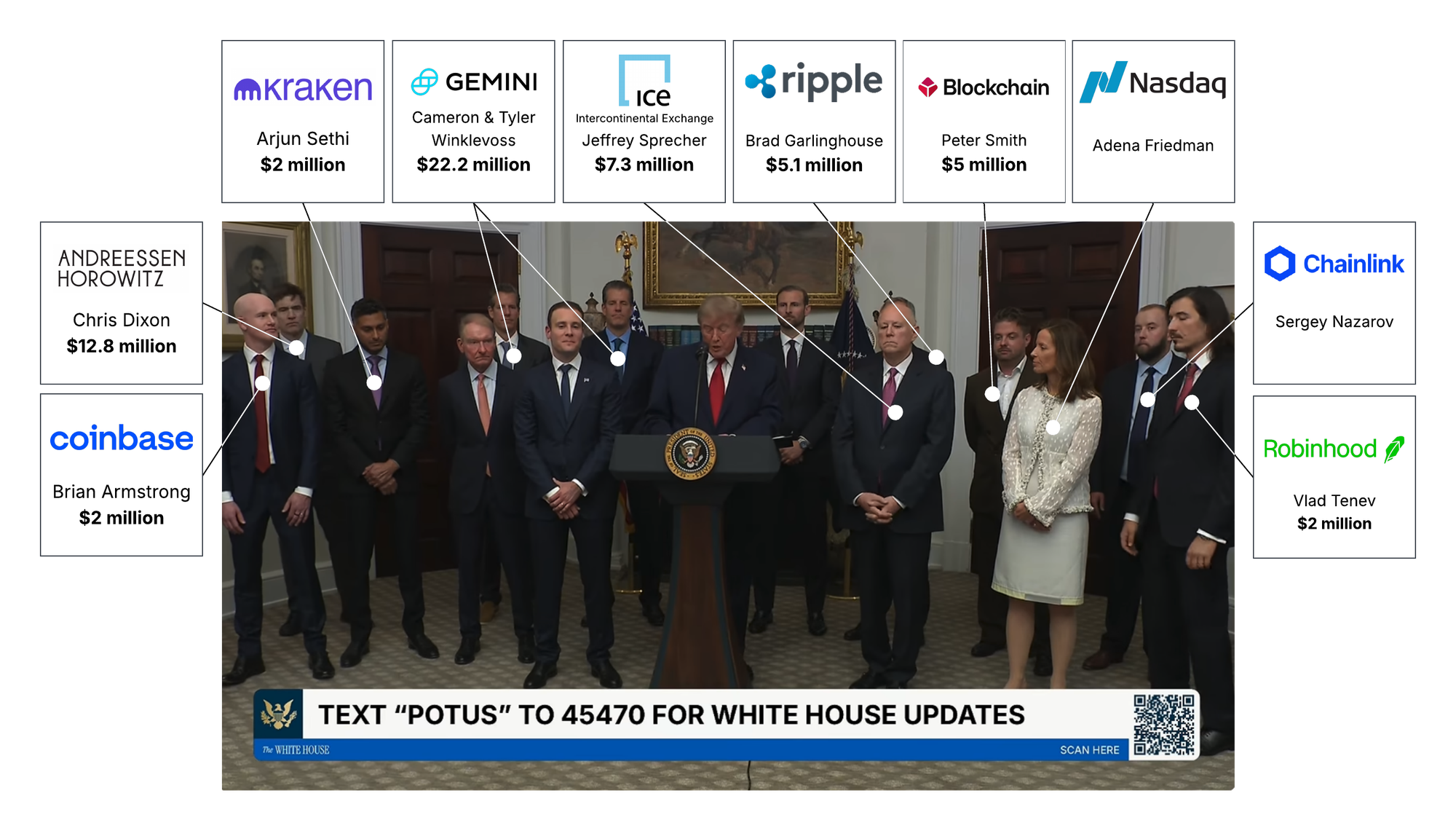
Bizarrely, Trump also namechecked Hyperliquid, a niche cryptocurrency platform known for its perpetual futuresa offerings on cryptoassets, traditional stocks, and commodities like oil. After noting that CFTC Chairman Mike Selig had in May authorized “the first ever true bitcoin perpetual futures contract on a CFTC-registered exchange” [I106], Trump added, “I understand that Mike is also working to bring Hyperliquid into the United States in a fully compliant and legal fashion.”
Politico reported that the namedrop came at the CFTC’s request, in hopes that it would demonstrate the agency’s eagerness to welcome crypto firms into the United States.1 Earlier this year, Hyperliquid set up its very own lobbying arm, the Hyperliquid Policy Center. “The U.S. faces a large challenge to rewrite the rules for the new chapter of DeFi,” said CEO Jake Chervinsky, who of course is more than eager to help.2
ICE contracts
The two biggest blockchain intelligence firms are fighting over a $95 million ICE contract, apparently the largest such contract ever offered by the US government. The contract, which outlines the need for blockchain analysis services to combat scams, ransomware, extortion, and sextortion was awarded without an open bidding process to TRM Labs. Its competitor, Chainalysis, was quick to file a lawsuit challenging the award, arguing they should have been allowed to compete for the contract.3
Trump business interests
Recent analysis from consumer rights watchdog Public Citizen estimates that investors in Trump’s crypto endeavors have lost $4.7 billion. They attribute most of these losses — $3.2 billion — to holders of the $TRUMP memecoin, where roughly 65% of holders have lost more money than they’ve made. Much of these losses are unrealized, meaning that people are still holding the tokens even as prices continue to sink.4 Public Citizen rightly notes that not all investors were likely looking for solely financial benefits, pointing to Justin Sun’s subsequent regulatory relief, and planned $TRUMP token purchases by entities like Freight Technologies, who in May 2025 announced a plan to purchase up to $20 million in $TRUMP because they thought it would be an “effective way to advocate for fair, balanced, and free trade between Mexico and the US” [I83].
Americans are broadly unhappy with Trump’s profiteering at their expense, and a recent Reuters/Ipsos poll found that 69% of all respondents — including nearly half of Republicans — believe that Trump’s businesses influence his decisions in office. However, 56% of Republicans responded that they believe corruption has improved under Trump.
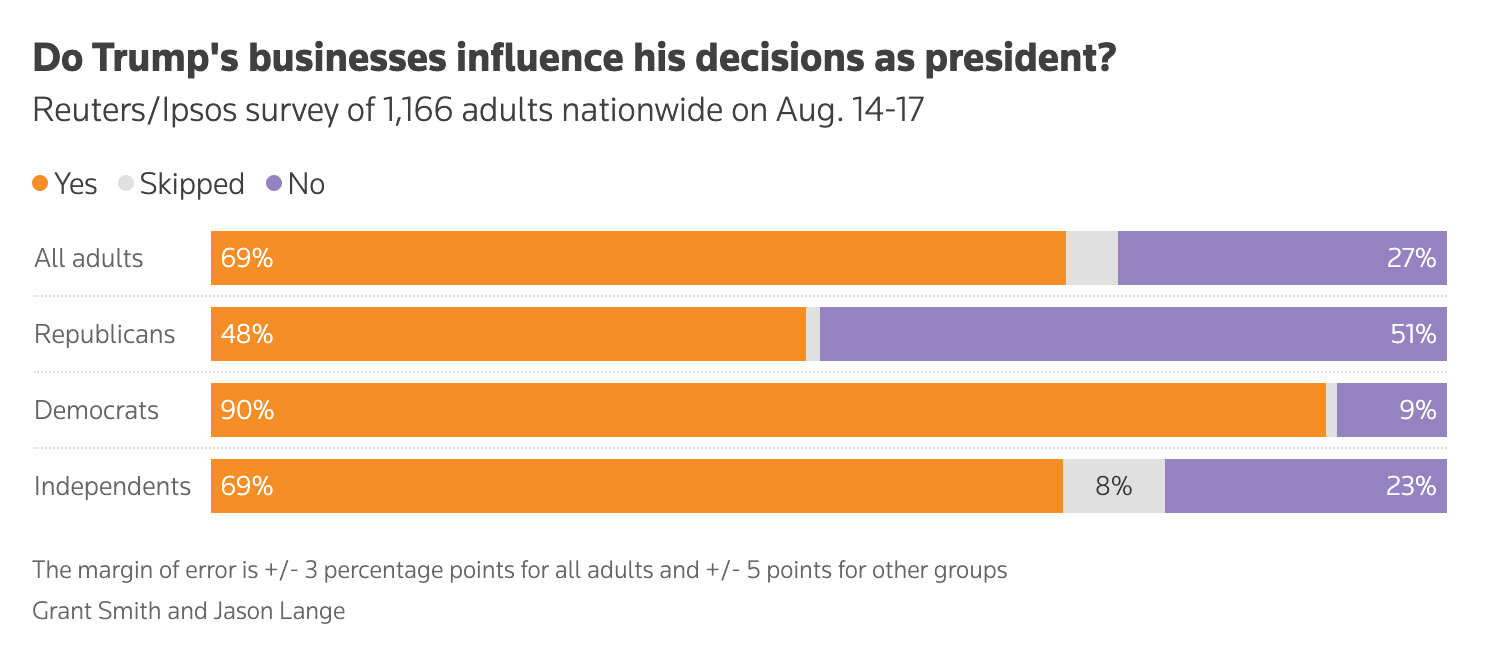
63% of respondents — 92% of Democrats and 27% of Republicans — don’t think it’s appropriate for Trump and his family to earn money from crypto.5
World Liberty Financial
The Trump family’s World Liberty Financial cryptocurrency business has won a conditional bank charter from the Office of the Comptroller of the Currency, which is led by Trump appointee Jonathan Gould [I107]. In its 13-page decision granting the approval, the OCC spends four pages summarizing the comments it received pertaining to the application:6
Two of the commenters discussed the OCC’s authority to charter the Bank, asserting, among other things, that the proposed activities do not align with OCC precedent with respect to fiduciary activities conducted by national trust banks. ... One commenter discussed issuance of a stablecoin by a national trust bank ... Four commenters expressed concerns about potential conflicts of interest involving the Bank, President Donald J. Trump and his family, Alexander and Zachary Witkoff, and United Arab Emirati investors in World Liberty Financial, Inc. Three commenters suggested that the Bank could receive preferential treatment by the OCC because the Comptroller is a presidential appointee. One commenter suggested that because the Comptroller is a presidential appointee, he could abstain from enforcing laws and regulations against the Bank or over enforce laws and regulations against rivals of the Bank. ... One commenter suggested that certain purchases of WLFI tokens could potentially violate the Emoluments Clause of the U.S. Constitution and implicate national security concerns. One commenter suggested that the OCC should postpone review of the application until certain non-U.S. investors divest their interests in World Liberty Financial, Inc. ... Several commenters argued that the OCC should not approve the application unless the Committee on Foreign Investment in the United States (CFIUS) reviews World Liberty Financial, Inc.’s ownership structure and investments into that institution from United Arab Emirati investors.
The OCC’s rebuttals are brief. In effect: World Liberty’s proposed activities are perfectly fine; the Comptroller has been completely ethical; emoluments concerns are out of scope for this application because WLFI tokens are issued by World Liberty Financial, not World Liberty Trust Company; and investors in World Liberty Financial would not have any investment in, or control over, the Bank.
The OCC’s dismissal of concerns over the UAE investments is particularly weird. They write that “investors in World Liberty Financial, Inc., would not have an investment in, or control over, the Bank”, yet elsewhere acknowledge an investment in the bank by StringZ Holdings. StringZ is backed by Sheikh Tahnoon bin Zayed and managed by Hamad Khlfan Ali Matar Alshamsi, a former director of Tahnoon’s G42.b G42’s CEO and general counsel manage Aryam Investment 1, which invested $500 million into World Liberty Financial in January 2025 [I101]. That’s the investment that the OCC is suggesting is irrelevant.
Shortly after the OCC’s preliminary charter approval, the Wall Street Journal reported that the UAE in fact does own 49% of the holding entity established for the bank — even more than the Trump family’s 38%.7 StringZ and two other entities signed “passivity commitments”: agreements confirming they would not seek to control the bank. According to the Journal, these agreements — relatively unusual in OCC decisions — were requested by OCC leadership in hopes of avoiding more questions from members of Congress, who had already objected to World Liberty’s application [I99].
Truth Social
News organization The Intercept and the Freedom of the Press Foundation have filed a lawsuit against President Trump, the White House, and some White House personnel over the new service in which subscribers who pay up to $100,000 per month to the president’s Truth Social platform gain preferential access to posts from the president and others [I107]. The API was marketed by Trump Media & Technology Group CEO Kevin McGurn as a way to gain advance access to the “most market-moving” posts, a category that includes the many official government announcements President Trump is fond of making on his own personal platform. The Intercept and the FoPF describe the scheme as “profoundly corrupt” and unconstitutional, arguing that the First Amendment guarantees equal access to official presidential announcements. “[E]ven content-neutral burdens on that access must be narrowly tailored to serve a significant government interest,” they write, arguing, “There is no legitimate interest, let alone a significant one, in permitting President Trump to profit from selling government information.”
When Truth Social announced its new data feed, they also announced that subscribers would gain access to an archive of historical posts, which would be made more challenging for non-subscribers to access. The news organizations argue this will further impede their reporting. The Freedom of the Press Foundation in particular maintains a “Trump Anti-Press Social Media Tracker” to archive the president’s attacks on the media. They say their access to such posts will be slowed to favor paid subscribers, and likely hampered by planned limitations on web scraping tools.8
In regulators
The SEC has unveiled its long-awaited proposed cryptocurrency regulatory regime: “Regulation Crypto Assets”, or “Reg Crypto”. The announcement was a bit of a surprise, particularly after an open meeting initially slated for mid-August was deferred at the White House’s request. According to crypto journalist Eleanor Terrett, the delay may have reflected worries about complicating Clarity Act negotiations [I108] or reports that SIFMA, a leading banking trade association, had signaled they would consider legal action if they felt the SEC overreached in its planned rulemaking.9
With the Clarity Act’s prospects at an all-time low, the CFTC and the SEC have both pledged to rewrite the country’s crypto rules with or without Congress. At the CFTC, Chairman and sole Commissioner Mike Selig convened the first meeting of his “Innovation Advisory Committee”, where he promised crypto CEOs he would “heed President Trump’s call to codify a future-proof digital asset market structure that cannot be undone by the crypto haters.”10 (Of the 43 members of the Innovation Advisory Committee, 28 of them represent crypto firms. Another six represent prediction markets or gambling companies, and only eleven are primarily focused on traditional commodities.)11
Whether because the SEC has given up on Clarity or has decided to take its chances with SIFMA in court, the agency suddenly released its 400-page proposed rule on August 18. The draft proposal would create an exemption allowing issuers to sell up to $5 million in tokens over an initial four-year period, or a somewhat more demanding avenue in which companies could offer up to $75 million in tokens per year, subject to heightened disclosure and reporting responsibilities. It would also establish a safe harbor program through which cryptoassets that meet specified criteria would cease to be treated as investment contracts, moving them outside the reach of the SEC. The proposal is now open for public comment; now we’ll see whether Wall Street thinks it goes too far, and whether crypto thinks it goes far enough.
In prediction markets
The New York Times recently outlined just how unusual it is for the CFTC to go on offense against the states challenging prediction markets. In its fifty-year history, the agency has never sued a state over a regulatory dispute. This year, it’s sued nine (and counting): Arizona, Connecticut, Illinois, Kentucky, New York, New Mexico, Minnesota, Rhode Island, and Wisconsin. All nine have Democratic governors, and eight also have Democratic attorneys general.
Even in states the CFTC hasn’t sued, they’ve exhibited startling overreach. In Michigan, after a state judge ordered Kalshi to cancel bets, the CFTC invoked its emergency authority to order Kalshi to disregard the court’s order. The agency argued that forcing bet cancellations “constitutes an emergency because it is a ‘major market disturbance which prevents the market from accurately reflecting the forces of supply and demand’”. They warned that letting the order stand “would risk shattering public confidence” in prediction markets.12
This was the CFTC’s first use of its emergency powers since 1980, when it suspended trading in grain futures amid market disruption following President Carter’s order to ban US grain sales to the Soviet Union. “How is being unable to gamble on sports online a market emergency?” said former CFTC enforcement director Aitan Goelman, describing the order as “unprecedented and frankly outrageous”.
In New York, the CFTC again invoked its emergency powers, directing Kalshi to keep operating after the state sought a temporary restraining order to halt the platform. Chairman Selig warned that New York intended to make prediction markets “waste away under its iron curtain of state gaming laws.”13
The CFTC’s blitz comes amid political pressure from the President and his family to shield prediction markets from state gambling regulators — pressure that overlaps with their financial interests in the sector. In early March, the Times reports, Donald Trump Jr. addressed Republican state AGs in a closed-door meeting, delivering a message the paper says “dovetailed with a message his father’s administration has sent to state leaders: Back off.” Trump Jr. is a paid adviser to Kalshi and both an investor in and adviser to Polymarket. The president’s Truth Social business has a marketing agreement with Crypto.com to promote its prediction markets, and recently introduced its $100,000-per-month API promising advance access to the platform’s “most market-moving” posts. Trump’s Truth Social posts routinely move traditional markets and resolve the outcomes of bets on prediction markets, where traders gamble on everything from his posting frequency to specific words he might mention to various government actions he often announces on the platform.
Insider trading
The popularity of prediction markets has brought with it a surge in suspected insider trading, as the sudden ability to bet on anything has tempted those with inside information about... anything. A recent report from the Anti-Corruption Data Collective flagged 556 wallets on Polymarket that exhibit characteristics of insider trading: frequently winning longshot bets on a small subset of markets and topics. Many of them made their bets shortly after registering on the platform, which the researchers say is a “possible sign they joined specifically to trade on privileged information”. And a parade of bots and “whales” (high-volume, high-activity, but likely non-bot traders) often follow these likely insider wallets into trades, suggesting a burgeoning sector of automated and human traders who are learning to look out for insider trading so they can then copy it.14
Of those 556 likely insider wallets, the researchers also noted that 152 of them were making their longshot bets on military and defense markets. Separately, CNN reported that Polymarket had referred to the Justice Department “dozens” of accounts that exhibited signs of insider trading on military-related contracts.15
Unsurprisingly, one of the people who agrees with most state attorneys general that prediction markets are definitely gambling, not financial activity, is Michele Spagnuolo, a Google engineer arrested in May for allegedly using his insider access to Google search data to profit from bets on the most-searched terms of the year. “Interpreting bets on Polymarket.com around Google’s trending searches to be swaps would ... produce absurd results,” his lawyers wrote in a motion to dismiss the indictment. “Taken to its logical end, the CEA’s definition of a ‘swap’ would reach virtually every kind of wager that could possibly exist, no matter how attenuated the economic consequence, including wagers on the outcome of a ‘neighborhood ping pong match,’ wagers between friends about the outcome of a reality television show, or even charity raffles.”16 That the person accused of federal felonies would argue that his activities were mere gambling is hardly surprising, given it would undercut the entire case against him.
Gabriel Perez, Trump’s former teleprompter operator who was using his advance access to Trump’s speeches to place profitable bets [I107], has agreed to disgorge just over $100,000 in profits and pay a $65,000 penalty.17
In elections and political influence
In Florida’s District 24, Democrat Oliver Gilbert won his primary despite $2 million in opposition spending from the Fairshake pro-crypto super PAC network. In ads that ironically urged voters to “follow the money”, the super PAC attacked Gilbert for accepting campaign support from a contractor that worked on a controversial proposed ICE detention facility in South Florida, “then, Gilbert allowed Miami–Dade to continue working with ICE”. A keen viewer might notice that the dates showed on the “headlines” (more on that in a moment) in the ad don’t match the narrative: the campaign support cites a story from July 2026, and Gilbert’s supposed subsequent allowance of ICE dates back a year prior.
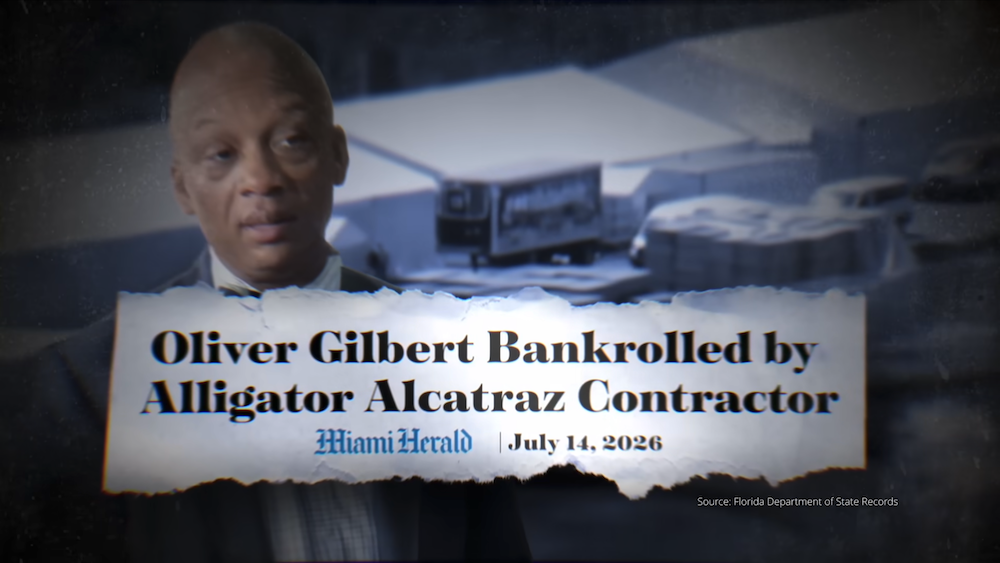

(via Tech Influence Watch)
The Miami Herald was also quick to note that the ad completely fabricated headlines it had attributed to the Herald, and misrepresented the stories the ad seemed to be referring to.18 The article about Gilbert supposedly “dodging” a vote to oppose ICE, the Herald clarifies, “mentions Gilbert in one sentence, which notes that he asked to indefinitely defer a vote to modify the county’s agreement with ICE after a procedural move by the Commission made the vote unnecessary.” One of the articles, which the ad references with a fabricated headline reading “Oliver Gilbert Approves $15 million for MAGA Donor’s Company”, does not even mention Gilbert.
Fairshake’s attempt to defeat Democratic opponents by linking them to ICE mirrors their similarly unsuccessful strategy against Illinois Senate candidate Juliana Stratton earlier this year [I102]. Of course, the ads talk about ICE because these PACs know that running ads about crypto would only alienate the voters they’re chasing. They don’t care about ICE whatsoever; Fairshake’s Republican arm has dumped more than $7 million behind Kentucky’s Republican Senate candidate, Andy Barr, who’s been running ads in which he proclaims, “I love ICE... Cheers to ICE.”19
In the courts
Jeong Sang-ho, the CEO of the South Korean Delio cryptocurrency exchange that collapsed in mid-2023, has been sentenced to 15 years in prison after he was found guilty of defrauding its customers. Victims lost approximately ₩70 billion (almost $50 million) [I30, 50].20
The Web3 is Going Just Great recap
There were ten entries between August 11 and 31. $47.46 million was added to the grift counter.
- More Markets exploited for $9.3 million [link]
- Crypto.com-affiliated Cronos blockchain halted after Tectonic theft [link]
- Exploit on Rain crypto payments infrastructure provider causes losses for “self-custodial” neobanks [link]
- Moonwell loses $8.7 million to fourth exploit in less than a year [link]
- Term Finance loses $8.5 million to governance attack [link]
- KiiChain, TAC, and other Cosmos-based blockchains exploited after “negligent” vulnerability disclosure [link]
- BounceBit exploited for $3 million, announces shutdown and migration [link]
- $1.76 million stolen from MAYAChain in attack exploiting six bugs [link]
- Ravencoin rolls back blockchain after exploit [link]
- Harmony token plunges 40% after unauthorized mint [link]
Worth a read
The Project on Government Oversight has done a great longform dive into the Trump family’s Alt5 Sigma $WLFI treasury company. The firm’s history is full of red flags, and there are multitudes of reasons both pre- and postdating its metamorphosis into a crypto treasury firm that the SEC might be interested in investigating more closely. However, there is one very president-shaped reason it might not, and a FOIA request by POGO that produced no investigation records related to Alt5 Sigma suggests no investigation has been opened.
In the news
Frequent New York Times opinion writer Thomas B. Edsall wrote, “I asked a wide range of crypto experts about the Trump family’s involvement in the industry, and more than half pointed me to an independent analyst, Molly White”, so that was pretty cool. He extensively quotes me in the op-ed about President Trump’s many crypto-related conflicts of interest, along with Cornell economist Eswar Prasad and Duke financial regulation scholar Lee Reiners.
I went on the podcast for the American Institute for Boys and Men to talk about prediction markets, cryptocurrency, and why so many young people — men in particular are drawn to those products. We spoke about their recent policy publication, titled “Prediction markets: Regulation, risks, and areas of research”.
I joined MediaJustice for a panel on tech money in politics, which is part of their broader series called “Brobots vs. the People”. Along with AI Now Institute Senior Fellow Aya Ibrahim and Tech Oversight Project Deputy Executive Director Kyle Morse, I spoke about the crypto and AI industries’ spending and strategies this midterm cycle.
I rejoined the TF gang not to talk about crypto (for a change), but about Grokipedia, the supposed Wikipedia-ender which has not published any updates since April.
That's all for now, folks. Until next time,
– Molly White
Have information? Send tips (no PR) to molly0xfff.07 on Signal or molly@mollywhite.net (PGP).
I have disclosures for my work and writing pertaining to cryptocurrencies.
Footnotes
A standard futures contract is a bet on what an asset will be worth on a specific date. Perpetual futures contracts (aka “perps”) remove the deadline, and allow traders to bet on an asset’s price indefinitely without ever owning the asset itself. In crypto, perps are a notorious feature of offshore margin trading at exchanges that offer extremely high leverage. ↩
Sheikh Tahnoon bin Zayed is the UAE’s national security adviser and brother of UAE President Mohammed bin Zayed. G42 is a state-backed AI firm, chaired by Tahnoon, and a beneficiary of the White House-backed AI chips deal from September 2025 [I93]. ↩
References
“Trump wants to bring an obscure crypto platform to the US. Wall Street will be watching.”, Politico. ↩
“Hyperliquid launches DeFi-focused policy shop led by prominent crypto lawyer Jake Chervinsky”, Fortune. ↩
Complaint filed on August 28, 2026. Document #1 in Chainalysis Government Solutions v. United States. ↩
“‘Thin Air,’ Real Money: Donald Trump’s Crypto Products Have Left Investors at Least $4.7 Billion Underwater”, Public Citizen. ↩
“Most Americans believe Trump has inappropriately profited since returning to power, Reuters/Ipsos poll finds”, Reuters. ↩
Corporate Decision #1385, Office of the Comptroller of the Currency. ↩
“Trump Family’s New Crypto Bank Is Backed by Abu Dhabi Sheikh”, Wall Street Journal. ↩
Complaint filed on August 12, 2026. Document #1 in The Intercept v. Trump. ↩
“The SEC Abruptly Postponed a Major Vote on Proposed Crypto Rules. What Happened?”, Crypto in America. ↩
“U.S. CFTC chief puts staff on notice to create crypto regulations if Clarity Act fails”, CoinDesk. ↩
Innovation Advisory Committee, CFTC. ↩
“CFTC Stays KalshiEX Rule Change and Exercises Emergency Authority to Order Fulfillment of Pending Trades”, CFTC. ↩
“CFTC Exercises Emergency Authority to Ensure Market Stability”, CFTC. ↩
“Classifying Insider Trading Risk: Analyzing the Longshot Betting Ecosystem on Polymarket”, Anti-Corruption Data Collective. ↩
“Polymarket referred dozens of possible military insider trading cases to DOJ, source says”, CNN. ↩
Memorandum in support of motion filed on August 26, 2026. Document #41 in US v. Spagnuolo. ↩
“CFTC Orders Gabriel Perez to Pay $172,000 for Insider Trading of Mention Market Event Contracts”, CFTC. ↩
“Pro-crypto PAC fabricates Miami Herald headlines to attack Florida Democrat”, Miami Herald. ↩
“2026 Ad Messaging Snapshot: Democrats Lean Into ICE In The Early Primaries”, AdImpact. ↩
Read more

On Meidas Defense: cryptocurrency, sanctions, and Trump quid pro quo
Last week I joined Joe Plenzler on the Meidas Defense podcast to talk about crypto. Meidas Defense is the MeidasTouch Network’s national security show, so we spent more time than I usually do on crypto as a geopolitical problem, in addition to a consumer protection one. The full episode

Issue 111 – Back the winners
A Trump crypto adviser’s firm took millions from Tether while he shaped stablecoin rules in their favor, a Senate probe targets Commerce Secretary Lutnick’s not-so-former firm, and crypto’s biggest super PAC plays it safe

Issue 110 – The Clarity Act collapses
Regulators race to reassure the crypto industry as the industry’s flagship legislation collapses, SBF tries his luck with the Supreme Court, and crypto PACs unleash $30 million against Sherrod Brown

The Senate must reject the Clarity Act’s ethics charade
The supposedly “unprecedented” ethics restrictions exempt Trump’s crypto businesses and leave enforcement to his loyalists