Sam Bankman-Fried’s helicopter parents crash into federal court
SBF praises Trump from prison, his parents beg for a pardon on CNN, and his legal ethics professor mother files court documents claiming to be from him — prompting a judge to demand he swear under oath who wrote them.



On Monday, Federal Judge Lewis Kaplan issued an order: Sam Bankman-Fried — currently serving a 25-year sentence for the massive fraud he perpetrated at his FTX cryptocurrency exchange — must declare, under penalty of perjury, whether attorneys drafted the supposedly pro se filings submitted under his name.
The order is the latest episode in an increasingly bizarre saga involving Bankman-Fried and his Stanford law professor parents, who are filing — and perhaps also drafting — legal documents on behalf of their 34-year-old son.
The whole mess began in February, when Barbara Fried — professor emerita of legal ethics at Stanford who retired in 2022a — filed on her son’s behalf a motion seeking a new trial before a new judge.1 This was odd from the start, as Bankman-Fried currently has an appeal under consideration before the Second Circuit, where a panel of judges heard his arguments in November that FTX merely had a liquidity problem, not a solvency problem, and that all his customers were repaid anyway, so no harm no foul. He also argued that he was deprived of a fair trial by Judge Kaplan, who presided over his 2023 trial, and who had prohibited him from discussing his reliance on FTX attorneys’ counsel after he opted not to present a formal advice-of-counsel defense [I96]. With an appeal open in which he presents the same arguments with the assistance of high-powered legal counsel, why file a separate motion at all — and why opt to proceed pro se (represent himself) despite having no legal background, rather than use those attorneys to help him draft it?
He probably shouldn’t, and legally, he can’t. A defendant cannot simultaneously be represented by counsel and proceed pro se. Furthermore, if either of his parents, or any other attorney, drafted the motion and then filed it claiming it was from their son acting pro se, they would be misleading the court. The pro se designation exists to give judges discretion to be more lenient with defendants who lack legal training, not as a vehicle for attorneys to file motions in courts where they’re not admitted while avoiding the requirements that would apply if they were openly representing their client.
If an attorney drafted Bankman-Fried’s motion, then it’s not pro se. If Barbara Fried wrote it, she’s practicing law in a court where she’s not admitted. And if Sam Bankman-Fried signed off on a filing claiming he wrote something someone else actually wrote, he’s lying to a federal judge.
The immediate risk is sanctions from Judge Kaplan himself. Federal judges have broad authority to sanction attorneys who mislead the court, including fines, referring the matter to bar authorities, or even holding the attorney in contempt. And beyond the immediate risk of court sanctions, Barbara Fried — as a member of the New York bar — remains bound by professional responsibility rules even when not actively practicing. Helping to file documents that misrepresent their authorship could subject her to bar discipline, potentially including disbarment.
Citation Needed is an independent publication, entirely supported by readers like you. Consider signing up for a free or pay-what-you-want subscription — it really helps me to keep doing this work.
The timeline
On February 10, Sam Bankman-Fried filed a motion for a new trial in front of a new judge. Attached to it was a cover letter from his mother, which explained, “Although Mr. Bankman-Fried is proceeding pro se, because he is currently incarcerated he has authorized me to file this on his behalf.”1
The government responded to the substance of the motion on March 11, without addressing the cover letter, arguing that “The motion is a transparent attempt to relitigate questions the jury decided, reassert factual claims the record refutes, and advance a political narrative the defendant committed to writing before his arrest.”2
Also on March 11, Barbara Fried published a Substack post comparing Judge Kaplan to Irving Kaufman — the judge who sentenced the Rosenbergs to death in the 1950s — and wrote that Kaplan “seems to take pleasure in his cruelty.”
The following day, she wrote to Kaplan’s court to request a three-week extension for her son to respond to the government’s reply brief. She identified herself as “the holder of power of attorney for Sam Bankman-Fried”, and explained that he was soon to be relocated from Los Angeles’ Terminal Island prison and thus would be “out of contact with the outside world for some period of time that is hard to predict at this point.” There were multiple problems with this letter, as Judge Kaplan would soon point out. While Fried may hold power of attorney for her son, allowing her to make a broad range of decisions on his behalf, it does not literally designate her as his attorney. And while Fried does maintain an active license to practice in New York State courts, she is not admitted to the bar of the Southern District of New York — nor has she requested pro hac vice admission.b Further, court staff informed Judge Kaplan that Fried, or someone identifying themselves as such, had left a voicemail with his chambers — an improper ex parte communication.c
Judge Kaplan responded on March 16 with a rebuke made more withering by his patience in spelling out the procedural matters that a law professor of forty years and formerly practicing attorney should clearly know, but nevertheless failed to follow.3
Ms. Fried is not a member of the Bar of this Court, has not sought leave to appear pro hac vice, and has not filed an appearance. A power of attorney granted by the defendant does not authorize her to seek relief from the Court or otherwise to participate in this litigation. The Court of course understands that Ms. Fried is the defendant's mother, was trained and practiced as a lawyer, and has taught at Stanford Law School. Nevertheless, with no disrespect,d she lacks standing to file papers or seek relief in this case.
But despite the reprimand, Kaplan said that he would, on his own initiative, grant a several-day extension to allow Bankman-Fried or his attorneys to request more time if needed.
On March 19, such a letter arrived, purportedly from Bankman-Fried himself.4 And while the government responded to say they did not object to a reasonable extension to accommodate Bankman-Fried’s lack of access to “legal work, counsel, or ability to communicate with the court”, they noted several questions pertaining to the letter’s authenticity.5e
The letter had arrived by overnight FedEx, with a return address of “S. Bankman-Fried, Terminal Island DOC, San Pedro, CA”.
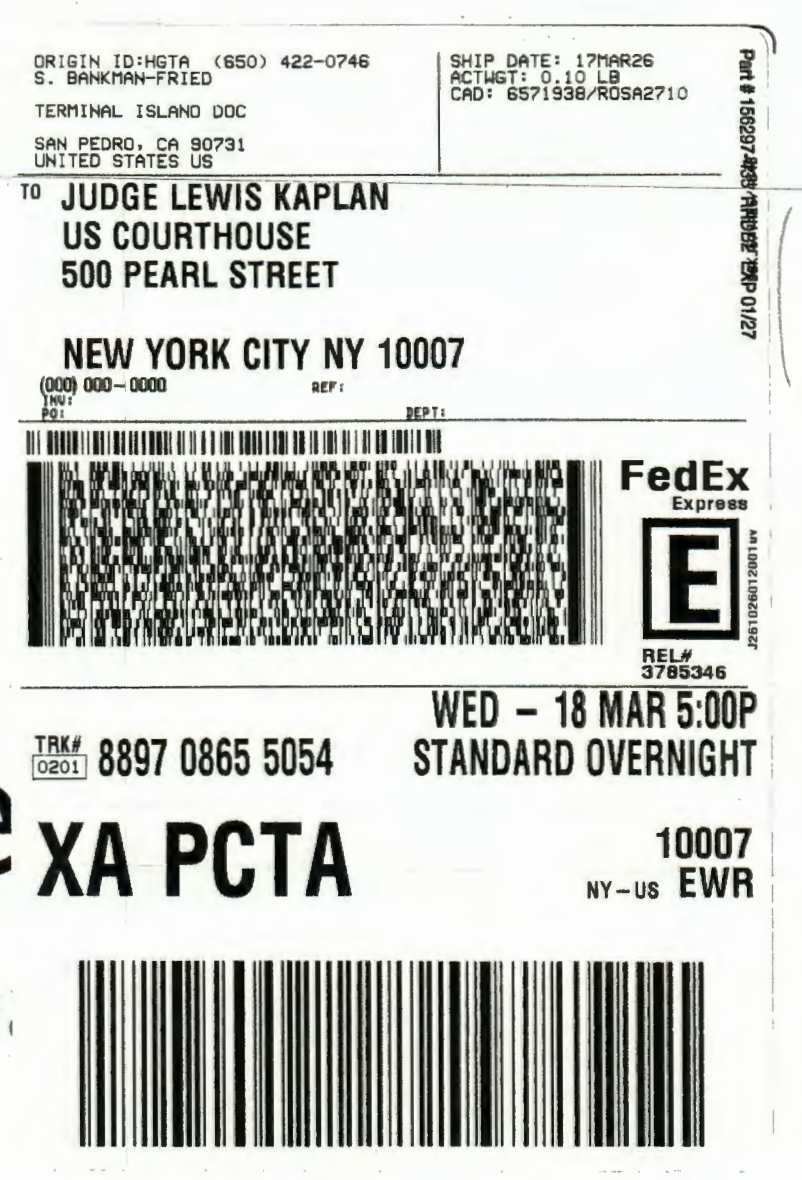
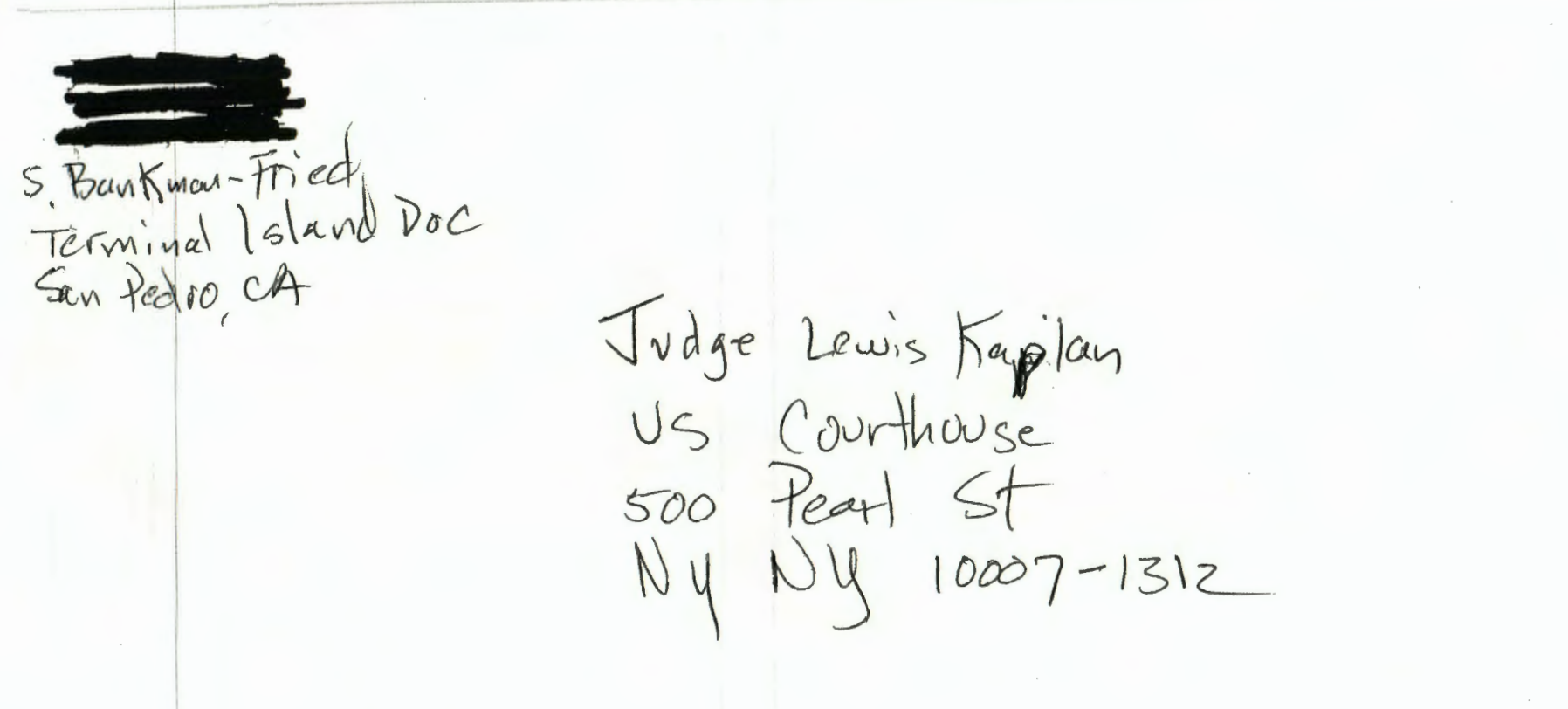
The FedEx label and envelope included with Bankman-Fried’s purported letter on March 19
But prosecutors noted that inmates are not permitted to send mail via private carriers, including FedEx. Terminal Island is also a Federal Correctional Institution (FCI) rather than a Department of Corrections (DOC) facility, an unlikely error for someone who’s been held there for nearly a year. They noted that the FedEx tracking number6 indicated the document had been shipped from Palo Alto or its neighboring Menlo Park — almost 400 miles from Terminal Island, but home to Bankman-Fried’s parents. Finally, the letter was signed with an “/s/”, rather than an actual signature.
Though prosecutors didn’t note it in their letter, the telephone number on the FedEx return address matches the one listed on his father Joseph Bankman’s California attorney profile.7
All of this is to say: the government has “reason to doubt that the ... letter purportedly submitted by the defendant was in fact sent by him”.5
On March 23, Judge Kaplan extended the deadline for Bankman-Fried’s reply — again, sua sponte.8 Simultaneously, he issued a memorandum and order noting that Bankman-Fried is at present being represented by several attorneys in his appeal, but nevertheless has attempted to file a pro se motion for a new trial. He explains that defendants represented by counsel may only “submit written arguments, speak in court, and do other things normally done by counsel only in the discretion of the district court”. To help him decide whether to exercise that discretion, and “to ensure that ethical rules are being adhered to by anyone involved”, Kaplan ordered Bankman-Fried must state under penalty of perjury whether his filings had been prepared by an attorney, and if so, by whom. He also ordered that any future pro se filings must include such a declaration.9
Bankman-Fried has until April 15 to respond.
Sam Bankman-Fried’s campaign
This motion for a new trial is part of a multi-front public relations and legal campaign by Bankman-Fried and his family to secure his freedom, alongside his ongoing Second Circuit appeal and an increasingly overt appeal for a presidential pardon.
From prison, Bankman-Fried has been posting to Twitter via a proxy; his account bio states “We can use BOP-approved phone calls / emails to tell others what to post on our socials.” Recent posts have heaped praise on President Trump, endorsing his war on Iran,10 claiming that oil prices have come down under his leadership,11 and stating that he “fixed the SEC”.12 He has endorsed Trump’s interpretation of his own legal troubles as an attack by a politically-motivated Justice Department, and claimed that he too is a victim of such attacks.13 (Although Bankman-Fried was publicly perceived as a Democrat, and was among Biden’s largest donors, he has decided that Biden caught wind of his straw and dark-money donations to Republicans and that the DOJ’s case against him was retaliatory.)
Television
On March 21, his parents made their pitch, sitting for their first televised interview since their son’s conviction.14 When asked by CNN’s Michael Smerconish what she wanted to say to President Trump, Barbara Fried made the appeal:
I think that Sam was the victim of an out of control prosecution. And I know that Trump himself feels he was. I would say also that Sam is one of the most brilliant, talented young men of his generation. And the amount of good he can do in this world, if he is free to live a life of — the life he wants would be of enormous benefit to the economy, to a lot of things Trump cares about in this world, and that he ought to regard Sam as a huge asset going forward for the country.
Throughout the interview, Bankman and Fried echoed their son: that he is innocent, that his companies were solvent throughout, that all customers were repaid with interest,f and that the prosecution was politically motivated. “The Biden administration had decided to destroy crypto,” Fried said. “I am describing a part of the Biden administration that I think did really bad things.”
Although the CNN interview was his parents’ first televised interview since the conviction, it was not their first public advocacy. As I mentioned, on March 11 — ten days before the CNN interview and the day before she filed the improper extension request — Barbara Fried published a Substack post. Although I briefly described her animus for Judge Kaplan, who she accused of harboring “visceral hate of Sam”, I barely scratched the surface.
Substack
Barbara Fried had launched her Substack, titled The Untold Story of Sam Bankman-Fried, in October 2025 with a link to a 65-page Google document outlining her version of events (which largely echoed her son’s). The blog sat mostly unused until earlier this month, when she published a post titled “Harmless Error” — ostensibly about the Second Circuit oral arguments, but dedicating substantial space to attacks on Judge Kaplan.
Early in the post, even though she notes that only 5% of federal criminal convictions are reversed, Fried cites “a few” unnamed lawyers who she claims commented that her son had “one of the strongest criminal appeals they could remember.” She claims they estimated chances of reversal in the “30 to 60 percent range” — perhaps the kind of overly optimistic assessment compassionate friends might offer a grieving parent.
But most of the post is spent on attacks aimed at Judge Kaplan, in the form of a lengthy comparison to Judge Irving Kaufman, a former SDNY judge notorious for presiding over the 1951 espionage trial of husband and wife Julius and Ethel Rosenberg. Kaufman secretly colluded with prosecutors throughout the trial, and as Fried writes, “his one-sided rulings for the prosecution virtually compelled the jury to convict”. Kaufman ultimately imposed death sentences for both Rosenbergs — an unprecedented outcome for an espionage trial, made even more extraordinary by the fact that the Rosenbergs had only acted as messengers. Fried writes that she “was struck by the similarities to Kaplan’s behavior in Sam’s case”. Though she writes that “no one would accuse Kaplan” of secretly colluding with the prosecution in her son’s case, she goes on to do precisely that — both arguing that Kaplan colluded openly, rather than secretly, with prosecutors, and later writing of “the intricate bait and switch that the prosecution and Kaplan orchestrated to deflect the jury’s attention from the charge that the funds were wrongly appropriated”. She suggests that Kaplan may even outdo Kaufman: “Kaplan, however, has one character trait that I don’t think Kaufman had, despite everything. He seems to take pleasure in his cruelty.”
Fried also devotes some time to a theory she claims was suggested to her, again by an unnamed party: that “Kaplan’s extreme animus towards Sam could be explained in part by Jewish self-loathing or a need to distance himself from a fellow Jew accused of a crime”. Though she writes that it had seemed unlikely to her, she finishes: “Notwithstanding the anti-Semitic hate mail we continue to receive, Sam’s Jewish identity wouldn’t be noteworthy either, at least to Kaplan. I think.” Though she claims not to hold the opinion, she nevertheless finds it worthwhile to mention, and hedges her position with a very pointed, “I think.”
Posting through it
Her behavior mirrors Sam Bankman-Fried’s own approach throughout his trial, when he demonstrated an almost pathological need to explain himself publicly. He launched a Substack where he laid out his version of events and legal theories in great detail [I17]. He spoke to journalists and participated in chaotic audio interviews on Twitter [I13] even as his lawyers likely begged him to stop creating such a robust record of sometimes contradictory statements that could (and would) later be used against him at trial. He tweeted constantly, right up until Judge Kaplan had finally had enough and yanked his bail after he leaked former lover and FTX co-executive-turned-star witness Caroline Ellison’s private diary entries to the New York Times [I36]. And ultimately, he opted to take the stand in his own defense, despite a largely unanimous opinion by outside legal commentators (and presumably his own legal team) that this would at best not help his case, and at worst be disastrous. Now, from prison, he has someone posting to Twitter on his behalf.
He constitutionally cannot help but post. And somehow he believes that this posting somehow aids his case: as though, if he can just explain his position clearly enough, everyone will finally understand. I am now beginning to believe his condition may be genetic.
But if the family hoped their multi-platform campaign would generate sympathy or support for a pardon, they badly miscalculated. Even crypto-friendly Republicans who might otherwise be sympathetic to claims of regulatory overreach under Biden have been emphatic in their rejection.
“The guy’s a piece of shit,” Senator Bernie Moreno (R-OH), a crypto industry favorite, told Politico. “The guy shouldn’t be pardoned. The guy should go to jail for a long, long time.” Longtime industry ally Senator Cynthia Lummis (R-WY) feels similarly: “I hope the president doesn’t fall for that. ... He hurt a lot of people.”
And Trump himself told the New York Times in January that he had no plans to pardon Bankman-Fried — a position his spokespeople reiterated in late February.15
Falls from grace
The parents’ involvement in their son’s business ventures had already been questioned long before this recent courtroom drama. In September 2023, weeks before Bankman-Fried’s trial began, the FTX bankruptcy team filed an adversary case against Barbara Fried and Joseph Bankman [I39], alleging they were unjustly enriched by around $30 million in benefits from the FTX fraud. These included a $16.4 million luxury property in the Bahamas and a $10 million cash gift. Joseph Bankman was described as heavily involved in the company’s day-to-day operations, providing legal and financial input, and ultimately requesting a $1 million salary. Evidence published during the trial showed him as a participant in several Signal group chats, including the “small group chat” that functioned as a war room as the executive team desperately tried to stop the collapse.
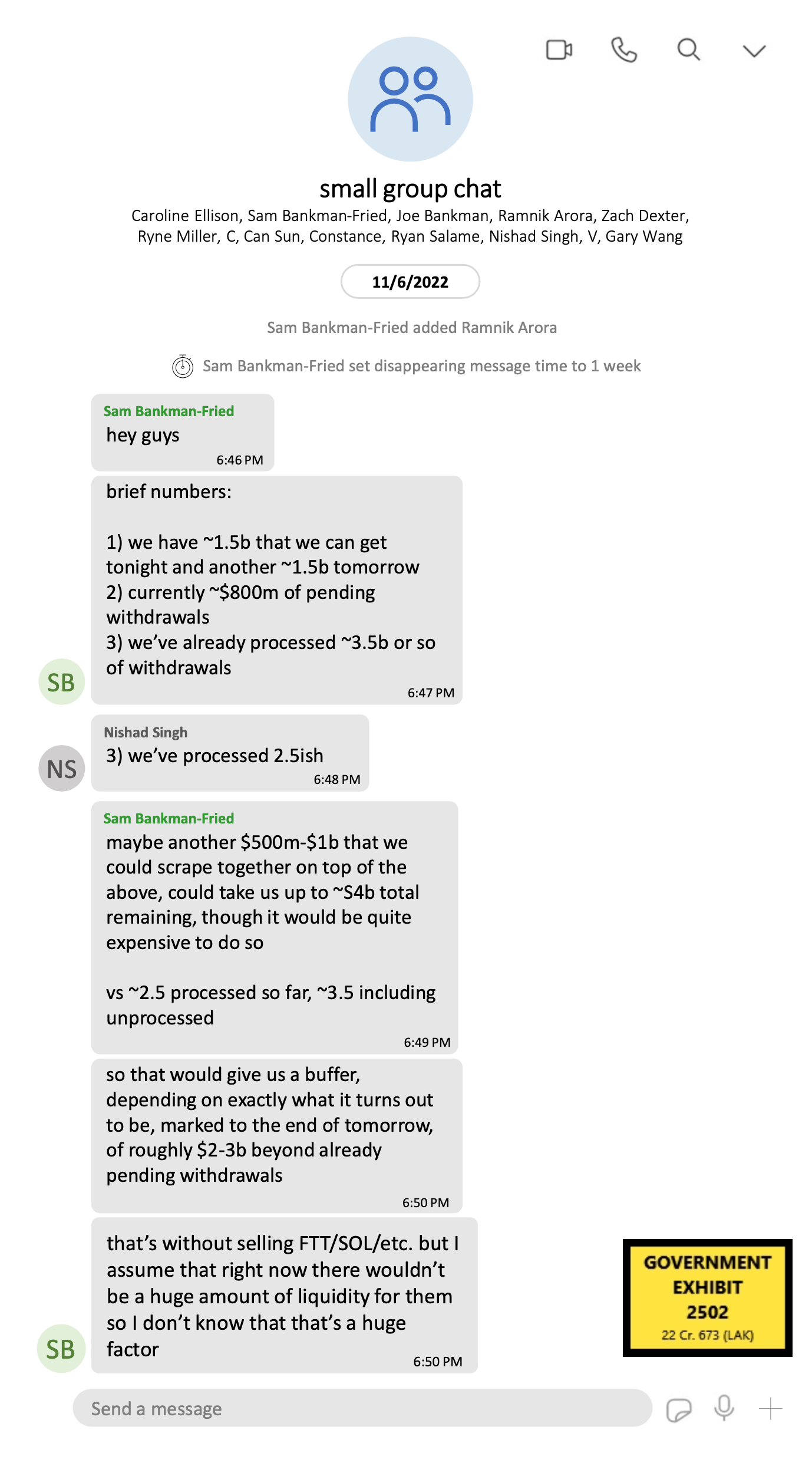
As for Barbara Fried, she was involved in FTX’s charitable spending, soliciting some of the donations that ultimately resulted in a criminal wire fraud conviction for executive Ryan Salame [Stones].
The adversary case was dismissed in late 2025, with no clear explanation of why or whether a settlement was reached [I80]. The parents were never criminally charged. At that point, they could have faded from public view.
Sam Bankman-Fried’s fall from grace was the inevitable outcome of his massive fraud. But his parents’ reputations are being destroyed right along with his. Barbara Fried, a legal ethics professor, is now suspected of engaging in unauthorized practice of law. Joseph Bankman’s phone number appears on suspicious mailings to a federal judge.
It’s difficult not to feel some sympathy for parents facing the reality that their son will spend 25 years in prison, and who understand that they may not live to see him released. But while their grief and desperation is understandable, their response — publicly attacking the judge, inserting themselves into their son’s legal schemes, and launching a scattershot pardon campaign across cable news and Substack — has accomplished nothing except to tarnish their own reputations and demonstrate precisely the kind of entitlement and inability to accept consequences that got their son into trouble in the first place. They seem unable to accept that their brilliant son committed fraud, unable to stop posting through it, and unable to recognize that their campaign to free him is only making things worse. The helicopter parents have followed their son all the way into federal court, and now they’re crashing right alongside him.
Have information? Send tips (no PR) to molly0xfff.07 on Signal or molly@mollywhite.net (PGP).
I have disclosures for my work and writing pertaining to cryptocurrencies.
Footnotes
Barbara Fried retired at the end of the 2022 fall semester, right as FTX collapsed. She told the Stanford Daily that this was a “long-planned” decision, and had “nothing to do with anything else going on.”16 ↩
Pro hac vice (Latin for “for this occasion”) allows attorneys who aren’t admitted to a particular court’s bar to request permission to represent a client in a specific case. ↩
Ex parte communications — contacts between one party and the judge without notice to or presence of the other party — are generally prohibited out of concern for fairness. ↩
My understanding is that “with no disrespect” is the judicial equivalent of “bless your heart”. ↩
There is an error in the government’s letter, where they refer to a “March 16, 2019 letter ... (See Dkt. 590).”. They’re referring to Bankman-Fried’s March 19, 2026 letter, which is Docket #590. ↩
This has been a bone of contention throughout the FTX bankruptcy, because the bankruptcy claims were based on the price of assets at the time of the bankruptcy filing, when they were lower than they had been in some time — and considerably lower than the prices throughout the bankruptcy [I58]. By the time many creditors were repaid $16,800 per bitcoin (on tokens they had purchased for as high as $70,000 prior to the bankruptcy), bitcoin had crossed the $100,000 mark. Nevertheless, those creditors have been deemed repaid in full by Bankman-Fried and the FTX bankruptcy team. ↩
References
Notice of motion by defendant Samuel Bankman-Fried for a new trial filed on February 10, 2026. Document #583 in US v. Bankman-Fried. ↩
Memorandum in opposition filed on March 11, 2026. Document #587 in US v. Bankman-Fried. ↩
Memorandum endorsement filed on March 16, 2026. Document #589 in US v. Bankman-Fried. ↩
Letter by Sam Bankman-Fried filed on March 19, 2026. Document #590 in US v. Bankman-Fried. ↩
Letter by USA filed on March 22, 2026. Document #591 in US v. Bankman-Fried. ↩
FedEx tracking number 889708655054. ↩
Alan Joe Bankman #93478, The State Bar of California. ↩
Order filed on March 23, 2026. Document #592 in US v. Bankman-Fried. ↩
Memorandum and order filed on March 23, 2026. Document #593 in US v. Bankman-Fried. ↩
CNN interview with Joseph Bankman and Barbara Fried, March 21, 2026 (transcript). ↩
“Sam Bankman-Fried is waging a social media campaign for a pardon—but President Trump will not give him one, says the White House”, Fortune. ↩
“Sam Bankman-Fried’s parents will not be teaching at Stanford Law School next year”, Stanford Daily. ↩


