I’m launching Tech Influence Watch as AI follows crypto into politics
Most voters don’t know that crypto and AI companies have spent more than $400 million this cycle to buy Congress. Let’s make that spending visible.



I’ve been running my website Follow the Crypto since 2024, tracking the cryptocurrency industry’s influence on our democracy. The industry spent more than $130 million buying the 2024 elections, and the strategy worked. Pro-crypto politicians have proposed or passed industry-drafted legislation that threatens to open the floodgates to even more predatory crypto products, regulatory agencies were gutted, and crypto executives bought direct access to the President and positions in the White House. Now the artificial intelligence industry is following the same playbook.
Continuing to track only crypto would mean missing half the story. The same operatives are running both campaigns. Josh Vlasto, longtime adviser and spokesperson for Fairshake — the cryptocurrency super PAC network responsible for the bulk of crypto’s 2024 spending — is now simultaneously heading Leading the Future, a pro-AI super PAC network.1 Chris Lehane, the political consultant and Coinbase board member who helped establish Fairshake and famously told Coinbase employees who questioned whether a crypto voter bloc existed that they would simply invent one,2 is now also an OpenAI executive and one of the people behind the Leading the Future PAC network.3 The same venture capital firms are funding both: Andreessen Horowitz, a crypto heavyweight in the 2024 elections, is now splitting its political spending across crypto and AI PACs.
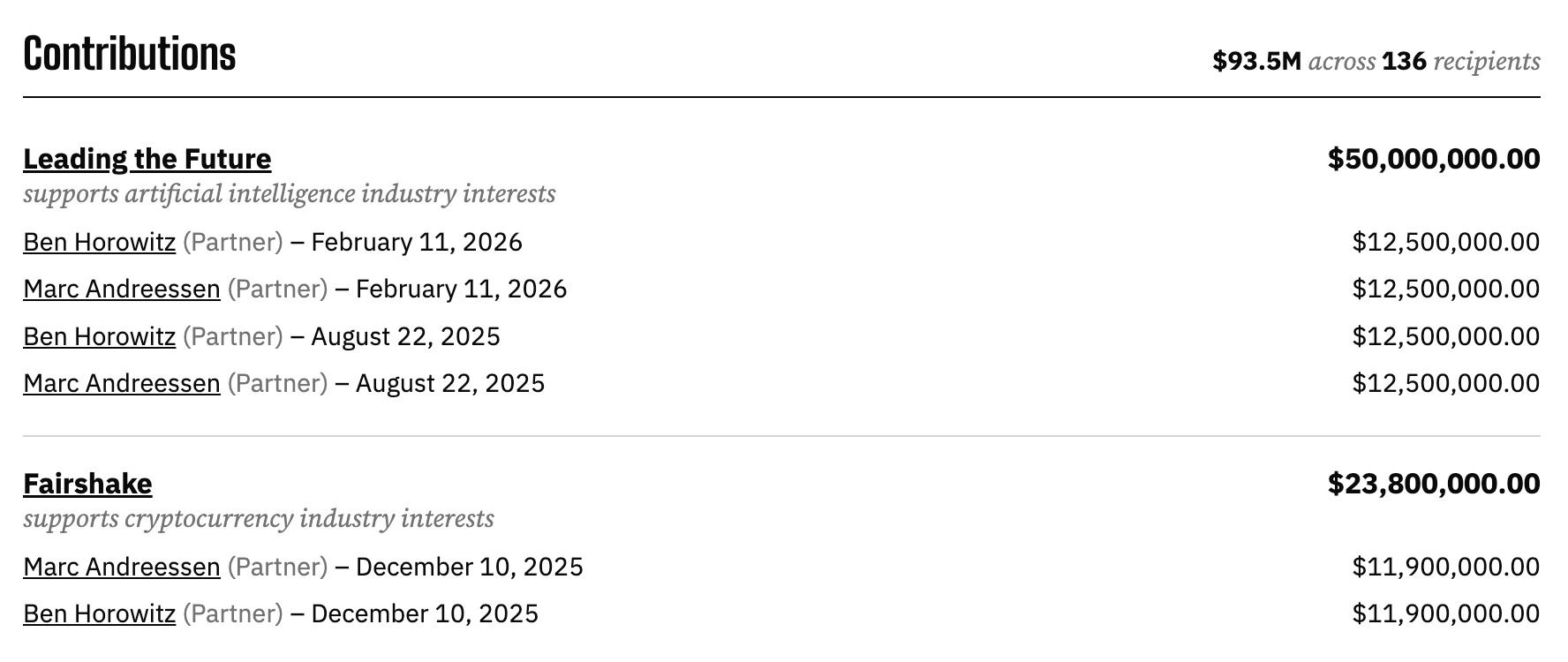
The PACs may look different from the outside, but they’re increasingly the same operation with aligned goals: deregulate the tech sector, slash consumer protections, and allow tech companies to capture even more enormous profits at the expense of everyday people.
So I’ve expanded the site to track both. It’s now called Tech Influence Watch, and it documents more than $400 million (and counting) in contributions from crypto and AI companies and their executives this election cycle. When two industries with shared backers and shared operatives are spending this much to write their own regulations, someone needs to be watching.
The site is live now at influence.citationneeded.news.a Here’s a little of what I found while building it.
The AI industry is fighting amongst itself
In New York’s rapidly approaching 12th Congressional District primary, two AI super PACs have spent nearly $10 million opposing each other. Think Big — backed by Andreessen Horowitz and OpenAI through the Leading the Future network — has spent $6.3 million trying to defeat Alex Bores, who has made tech regulation a pillar of his platform. Jobs and Democracy PAC — backed by Anthropic through the Public First network — spent around $3.5 million supporting him.
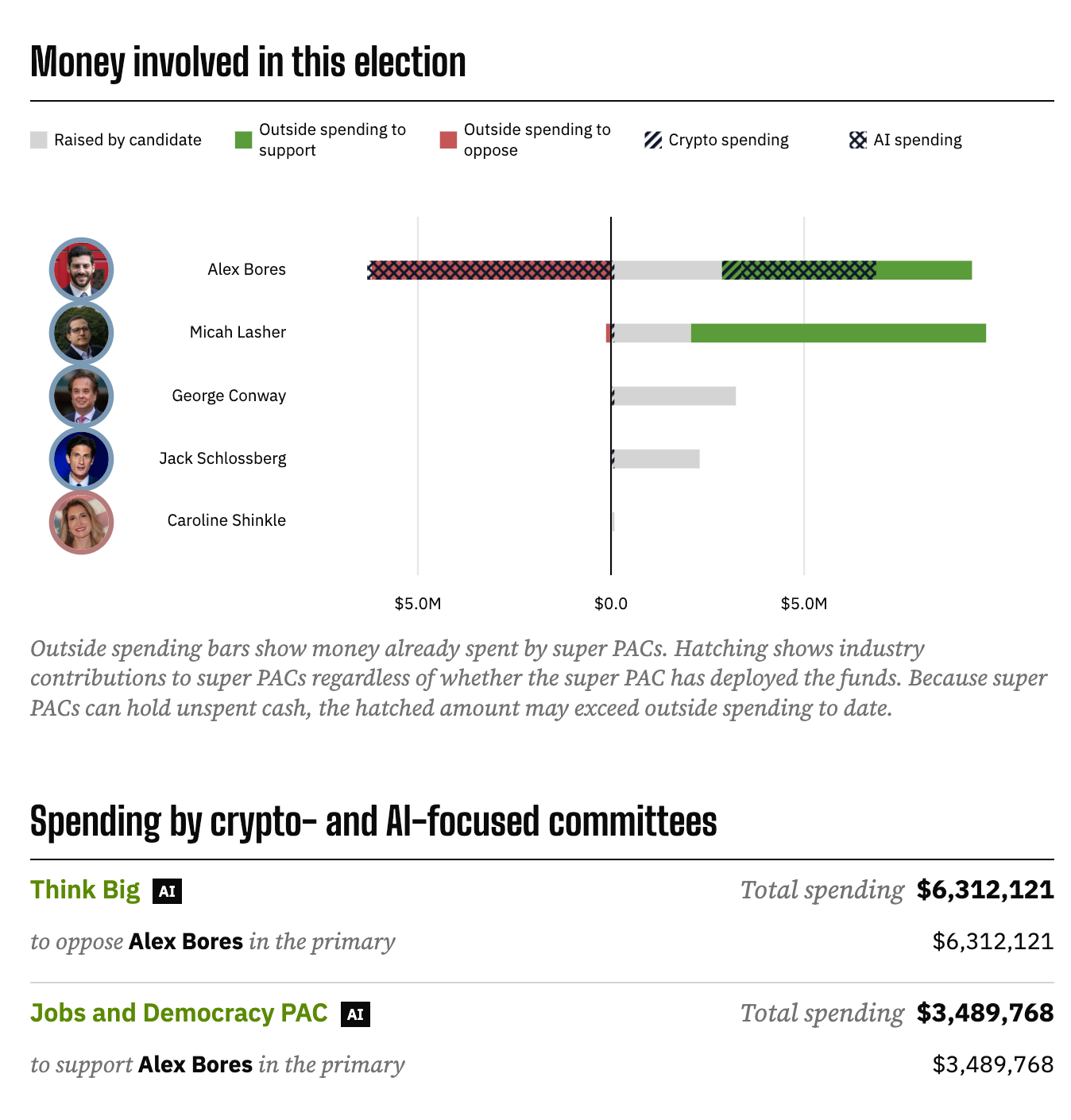
The policy rivalry mirrors a corporate one. OpenAI and Anthropic are two of the most prominent AI model developers, and direct competitors. OpenAI’s approach is essentially “don’t regulate us”. Anthropic, on the other hand, claims to champion “AI safety” and stricter regulations, offering its policies (and, by extension, its product) as the responsible alternative. While the companies and their respective super PACs frame the clash as a policy debate, from the outside it looks far more like tug-of-war between competitors trying to yank the regulatory environment in their direction.
But mostly, crypto and AI are coordinating
While AI PACs squabble, they’re still spending far more often alongside crypto money in the same races. So far, I’ve found 15 races where both industries are active, totaling $26.5 million. The most common pairing is, unsurprisingly, Fairshake and Leading the Future — the crypto and AI PACs that share operatives and are both substantially backed by Andreessen Horowitz. Defend American Jobs (the Republican arm of the Fairshake crypto PAC network) and American Mission (the Republican arm of Leading the Future) have spent together in seven races, always backing the same candidate.
With Vlasto and Lehane running operations for both, it seems unlikely this is coincidence. In most cases, the two PACs simply support the same candidates. But in others, they split their approach in ways that achieve the same outcome while obscuring the source of the money. In Illinois’ 2nd District, AI money supported one candidate while crypto money opposed their opponent. The different tactics still worked toward the same result, but masked the true scale of tech industry money shaping a race that will impact the lives of the district’s 730,000 residents.
The crypto playbook worked
The cryptocurrency industry’s 2024 spending helped install at least six new pro-crypto Senators and more than a dozen crypto advocates in the House. They defeated major regulatory and consumer protection advocates, including Democratic Senate Banking Chair Sherrod Brown, whose Republican opponent Bernie Moreno enjoyed $40 million in crypto PAC support. Since taking office, Moreno has used his seat on the Senate Banking Committee to become one of the chamber’s most aggressively pro-crypto voices — voting for the GENIUS Act and co-authoring the market-structure discussion draft that advanced the CLARITY Act through the committee.
Since 2024, Donald Trump has received hundreds of millions of dollars in campaign contributions from crypto and AI companies and their executives. Many of these same companies personally enriched him by more than $1 billion through business deals tied to his crypto ventures.
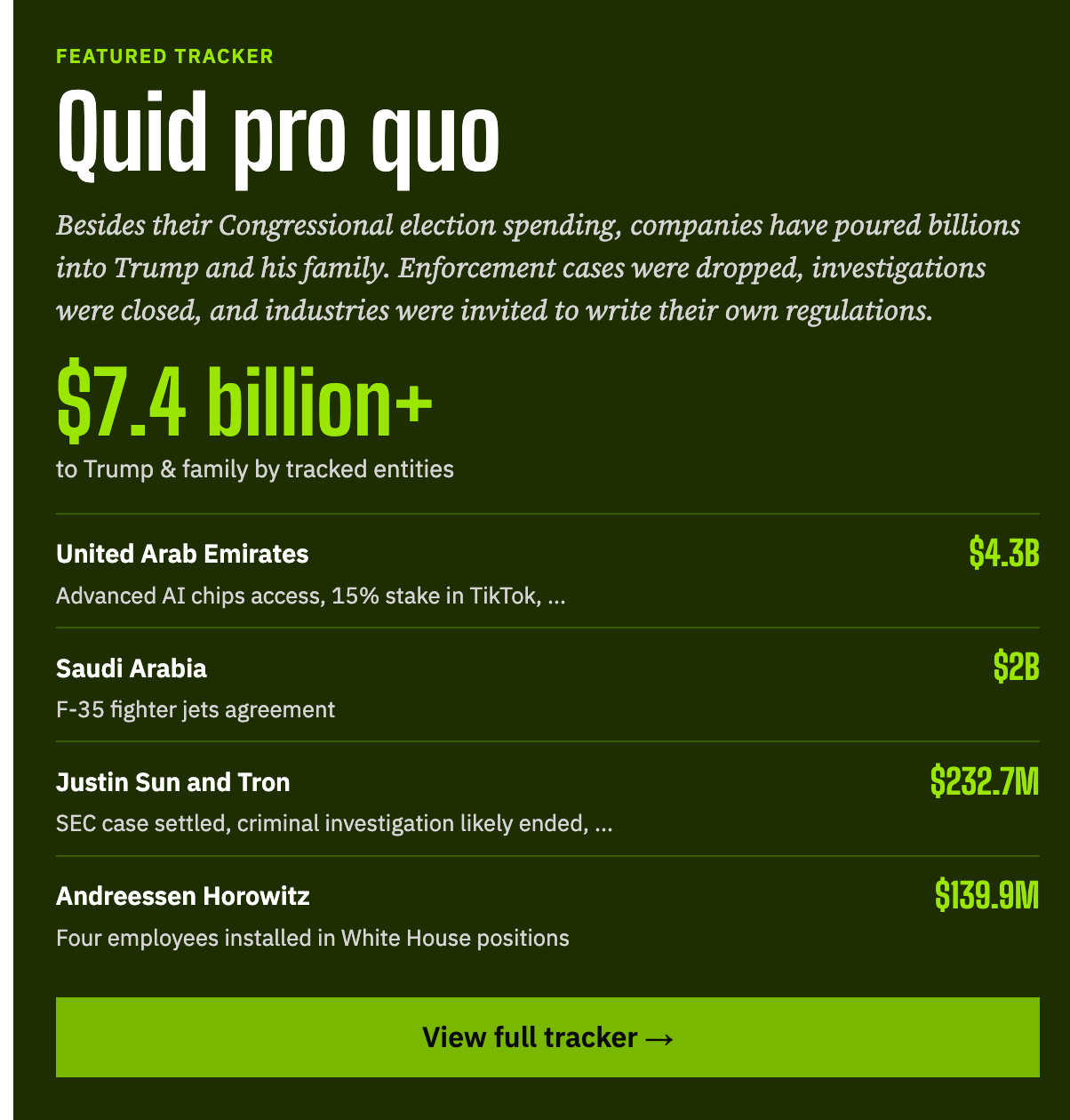
After his election, Trump staffed the White House with crypto and AI venture capitalists, giving the industries direct access to policymaking at the highest levels. He pushed for deregulatory legislation that would benefit these industries and, by extension, his own businesses. Since then, we’ve seen at least 21 enforcement actions or investigations against crypto companies dropped or paused, industry-written legislation advanced through Congress, and regulators who had pushed for consumer protections replaced with Trump loyalists who gutted the agencies’ regulatory capacity. Trump’s crypto appointees have used their influence to push forward ideas like a Bitcoin strategic reserve. Congress, itself also shaped by hundreds of millions in industry spending, has refused to address Trump’s blatant crypto-related corruption or provide meaningful investigations and oversight.
Despite just how overt Trump is being with these deals, most people have no idea of the quid pro quo that’s happening. Companies like Tron, Coinbase, Ripple, and Gemini have spent tens or hundreds of millions on campaign contributions, Trump-issued crypto tokens, business partnerships that favor Trump and his family, and donations to Trump pet projects — from the East Wing ballroom renovation to military parade sponsorships. And they immediately reaped the benefits.
SEC enforcement cases, and possibly criminal investigations, were dismissed or dropped. Regulators reversed course on crypto oversight, and have recently even been working to vacate completed cases from the previous administration. Financial authorities issued national trust bank charters [I98, 101, 102] and approved applications allowing these companies to expand into the traditional financial system in unprecedented ways [I102].
The United Arab Emirates invested billions in ventures that benefit the Trumps, including in the Trump family’s World Liberty Financial crypto project and via a $2 billion investment in the Binance crypto exchange denominated in the Trump family’s stablecoin.b Soon after, they got the okay to purchase restricted AI chips [I83, 87, 93, 94]. Saudi Arabia partnered on a Trump crypto project, then received approval to buy F-35 fighter jets — military technology they’d been denied out of fears it could end up in China’s hands [I97]. And the corruption isn’t limited to just Trump — one of the key negotiators in these Middle East deals is Steve Witkoff, who has still not clearly divested from his financial interests in World Liberty Financial, where his son remains an executive.
What AI companies are hoping to buy
AI companies are spending heavily to shape policy around artificial intelligence development and regulation. They’re fighting local oversight and moratoriums that would give communities power to reject the resource-intensive AI data centers they increasingly oppose.4 Some industry PACs are working to block state or federal legislation that would impose stricter regulations on AI companies, hold them liable for harms caused by their products, require safety assessments, or limit surveillance.
And while others — like Anthropic, through its Public First network — claim to champion safety, these efforts often serve to disadvantage competitors rather than protect the public. Both factions echo the crypto industry in framing their self-serving lobbying as principled advocacy aimed at defending innovation, the public, or the country, while in reality a handful of well-funded companies are working to shape regulations that will benefit their businesses at the expense of everyone else.
Voters don’t know this is happening
Most voters have no idea any of this is happening. In the next few weeks, voters in South Carolina, Alabama, California, Georgia, and Oklahoma are heading to the polls in primaries where crypto and AI super PACs are active — and most of them don’t know it.
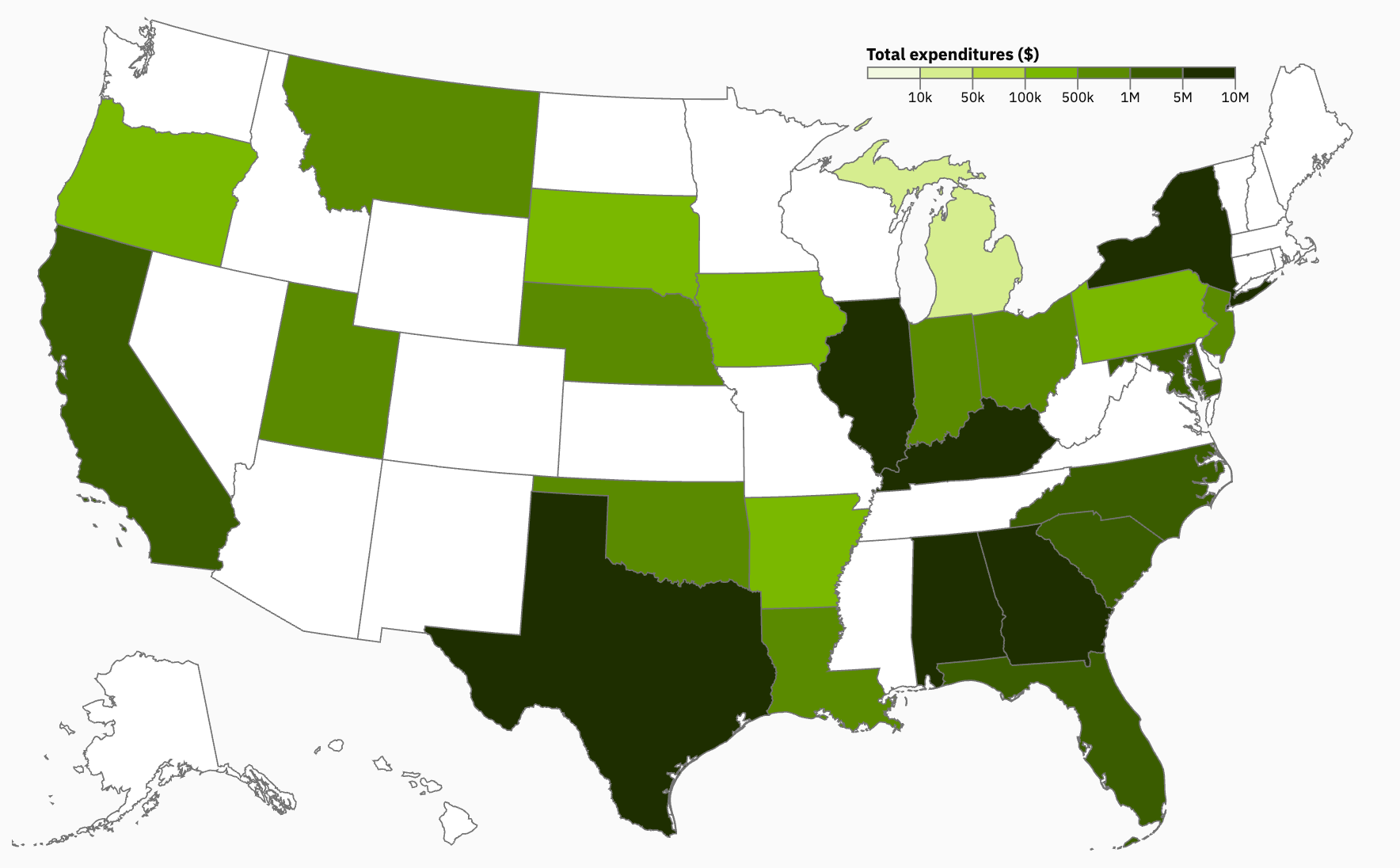
And in every state, crypto and AI companies and their executives have contributed directly to candidates — most from outside those states, with no offices or ties to the communities they’re trying to influence.
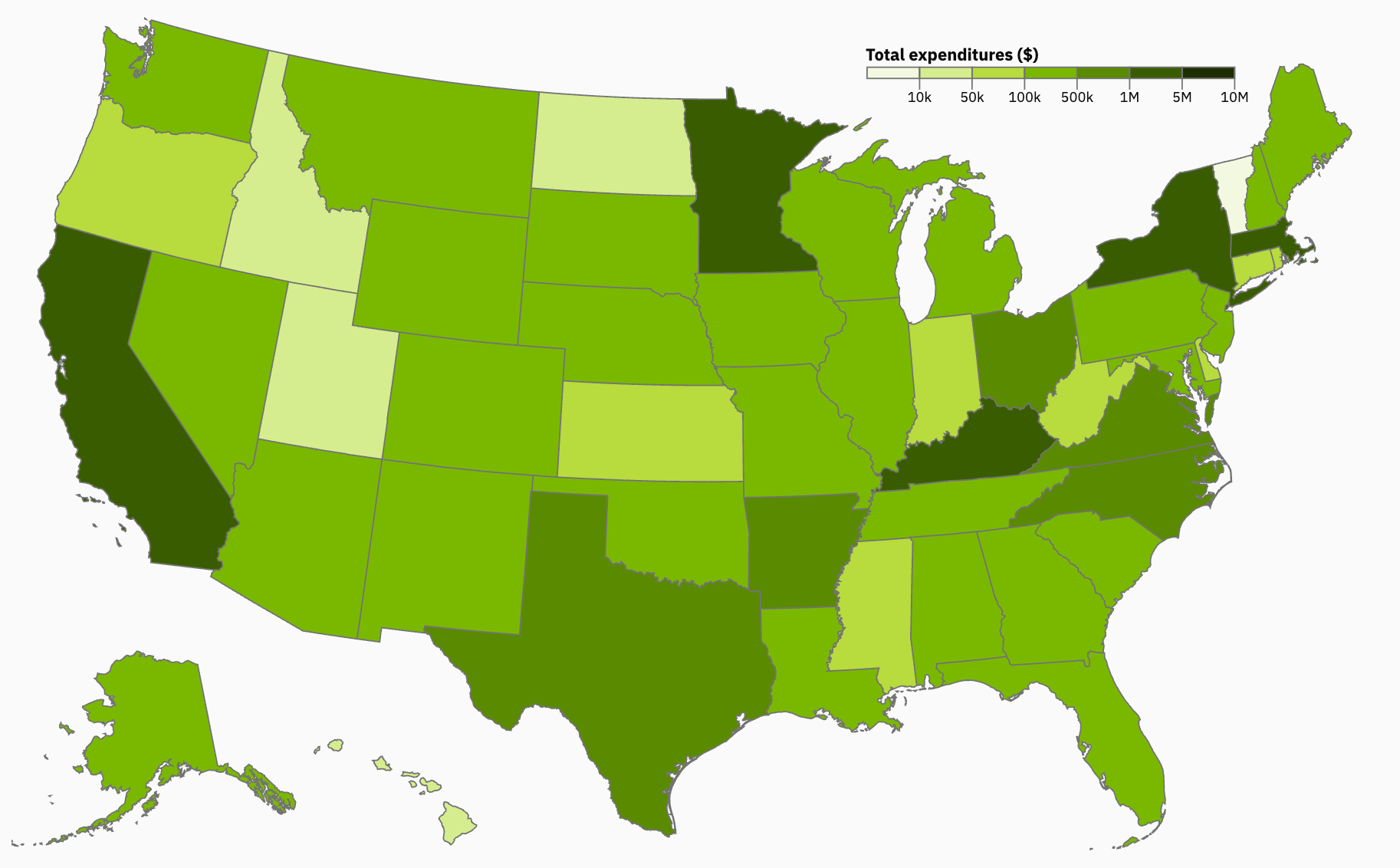
Much of the industry spending is intentionally obscured through super PACs that run ads that don’t mention the industries funding them, or even the topics they’re trying to address [I101, 102]. Candidates backed by crypto and AI money don’t typically campaign on crypto or AI policy — they run on other issues while quietly committing to industry-friendly positions.
In 2024, voters in Ohio never saw ads about crypto policy when Fairshake spent $40 million to defeat Sherrod Brown. They saw ads promising that his opponent, Bernie Moreno, would bring manufacturing jobs to the state and “stop[] illegal immigrants from taking Ohio’s tax dollars”.56 By the time most people learned who funded the campaign, the election was over and Brown’s crypto-friendly replacement was already being sworn in.
A recent CoinDesk survey found that 73% of voters disapprove of government officials having crypto business ties, yet 55% weren’t aware that the president is personally involved in the industry, and only 17% knew he co-founded World Liberty Financial.7 These PACs are exploiting that gap, spending massive amounts to install friendly politicians while hoping that voters won’t wake up to who’s funding these campaigns and why.
But when voters do learn about this influence, they often reject it. In Illinois, both Juliana Stratton in the Senate race and La Shawn Ford in the 7th District called out the crypto industry’s spending against them. (Ford even wound up sending a cease-and-desist to Fairshake over an attack ad he alleges falsely portrayed him as corrupt, a convicted felon for bank fraud, and someone who had abused his power in the Illinois state legislature [I103]). Both candidates ultimately won their primaries, despite the millions in opposition spending that dwarfed their own fundraising. I think this demonstrates that when voters know where the money is coming from, and candidates are willing to challenge it, the industry’s spending can become a liability rather than an advantage.
The stakes are high
The scale of industry spending is fueling overt government corruption. The deregulatory agenda they’re buying poses urgent threats to financial stability, consumer protection, and democracy itself.
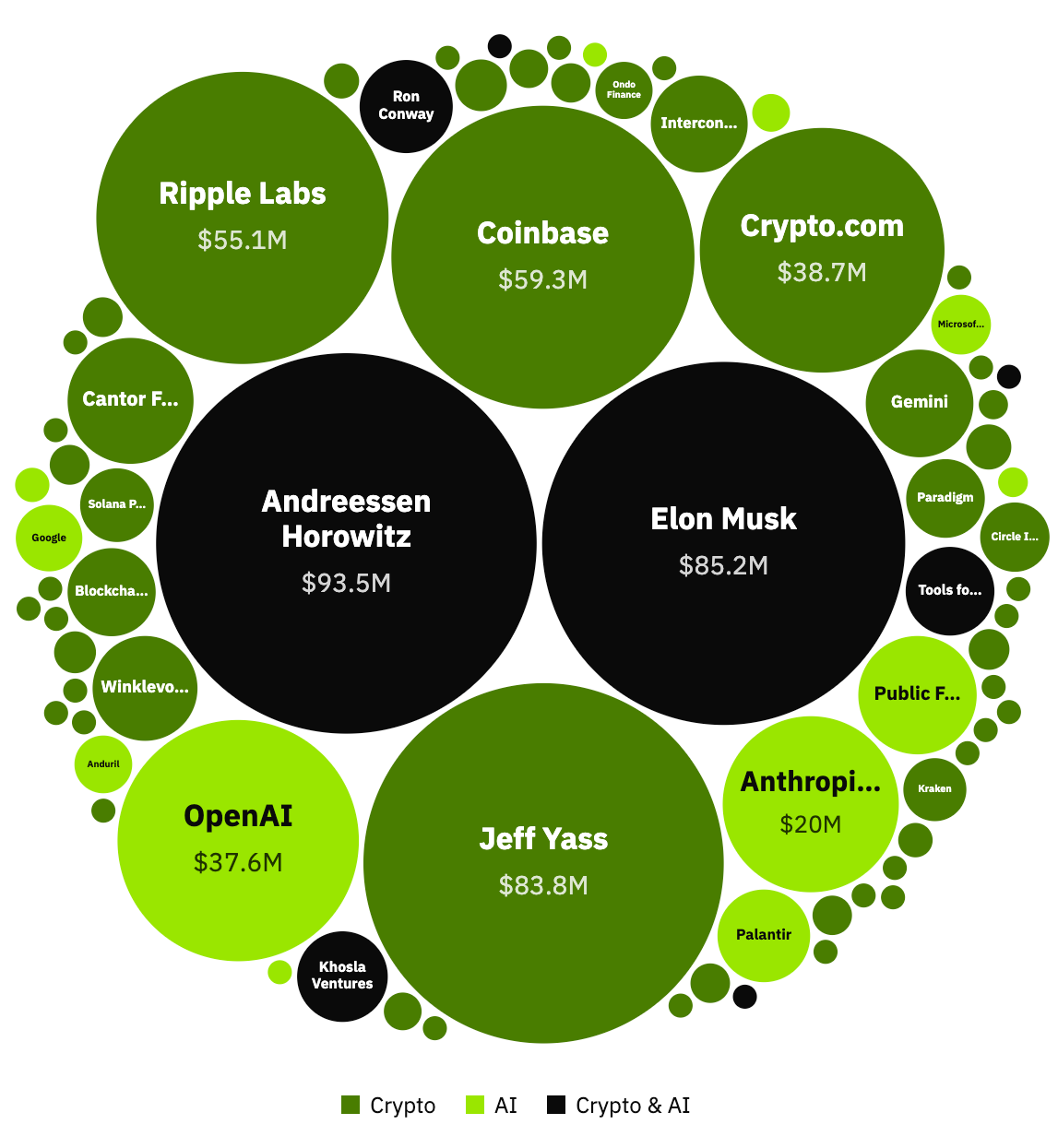
In crypto, it threatens to destabilize our economy. We saw crypto collapses in 2022 — Terra/Luna, Celsius, Voyager, FTX, and others — wipe out billions in customer funds, devastating everyday people who had bought into the hype. Those collapses happened under relatively light regulation, and the rules that existed were poorly enforced. Regulators had the authority to act but often didn’t, allowing fraudulent operations to continue until they inevitably collapsed. Now the industry has bought enough political influence to dismantle even what little oversight existed, and is now hard at work pushing Congress to lock in that damage, hoping to block future administrations from rebuilding the regulatory capacity they’ve gutted.
The end result could be a financial crisis that devastates individuals, families, and communities, regardless of whether they invested in crypto or not. The industry is lobbying for charters that let crypto companies access banking rails, for permission to custody crypto assets alongside traditional securities, and for crypto ETFs and other products that tie cryptocurrency prices to retirement accounts and institutional portfolios. The more these entanglements proliferate, the higher the risk that the next crypto crash won’t stay contained to crypto. It could trigger contagion throughout the broader financial system, even requiring a 2008-style bailout that costs billions in taxpayer money. The same industry now dismantling oversight would be first in line, hands outstretched for a government rescue — and we’ve recently seen how this plays out. In 2023, when Silicon Valley Bank collapsed, venture capitalist David Sacks took to Twitter to demand that the Treasury and Federal Reserve step in to protect the uninsured deposits of tech firms, which the government ultimately did. Sacks now has a much more direct line than just tweeting: he’s Trump’s Co-Chair of the President’s Council of Advisors on Science and Technology and, until recently, Special Advisor for AI and Crypto [I103].
AI poses different but similarly serious risks, all flowing from the same basic problem: companies capturing profits while the public bears the costs. Unchecked AI development threatens to invade privacy, amplify surveillance, perpetuate and systematize discrimination, and concentrate enormous power in the hands of a few companies. The resource demands of AI data centers strain local infrastructure and energy grids, often over the objections of the communities forced to host them. And the rush to deploy AI systems without adequate safety testing or corporate liability frameworks means the public bears the risk while companies capture the profits, immune from consequences for any harms they might cause.
Across both industries, we’re watching companies spend hundreds of millions of dollars to put their interests above those of everyday people, who rely on their legislators to represent them on a range of issues far broader than just the tech sector. And they’re hoping to buy the right to harm people without facing consequences, and to strip away communities’ abilities to have any say in decisions that will affect their lives.
That’s why making the public aware of this spending in real time matters more than ever.
What’s new
I’ve renamed Follow the Crypto to Tech Influence Watch and significantly expanded it to track both cryptocurrency and artificial intelligence industry spending. The site now documents more than $400 million in contributions from these two industries this election cycle, ranging from industry super PAC activity to companies and their executives contributing directly to candidates. If you’re interested in one sector or the other, you can filter the view to hone in on the information you want.
The site tracks individual races, showing which candidates are receiving support or opposition, from which PACs, and how much. It shows how the PACs operate in networks, and the companies funding them.
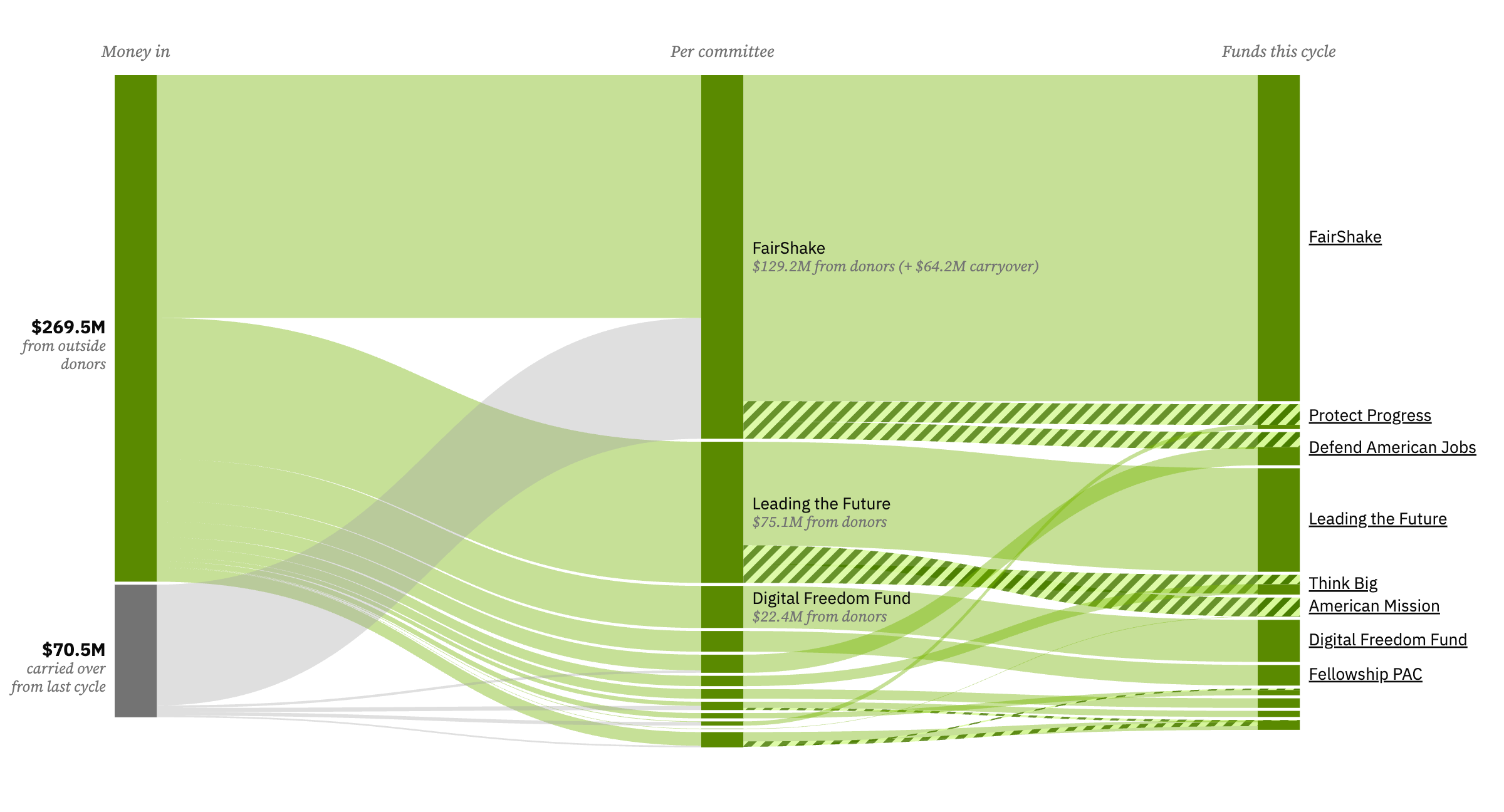
It shows which industries are active in which races and where their interests align. And it updates in close to real-time as new filings come in from the Federal Election Commission.
You can look up your own state, find your district, and see which races crypto and AI money is targeting near you. Check candidates to see who’s backing them, or explore individual companies to see where they’re directing their political spending. If you’re heading to the polls soon, look at whether the candidates on your ballot are receiving industry support — and if so, how much and from whom. Challenge them to put your interests ahead of their corporate backers.
Look up information about races in your friend or family’s states to send to them. Send links to local journalists who can use the data to enhance the type of on-the-ground reporting with context from their communities that they can do much better than I can. (For a great example of this, see Ryan Ottignon at The Daily Northwestern, who used Follow the Crypto data to augment their coverage of Illinois primaries.)
This launch is also part of a broader shift: I’m bringing more of my data work under the Citation Needed umbrella, where it belongs. Tech Influence Watch is now explicitly a Citation Needed project, documenting tech industry behavior in real time as I provide the longer-form analysis and context in the newsletter you’re reading now. It only makes sense they live under one roof given how much they support each other: the data projects give me the foundation for the reporting you’re reading, and throughout my writing I link back to them so you can dig deeper into the specifics. (You’ll see these links marked with a spotlight icon going forward — just as links to Follow the Crypto were previously marked with a ↓.) And I have more accountability projects like this coming soon.
Why I’m doing this
Voters don’t want this. Like CoinDesk’s poll found, 73% of people disapprove of government officials having crypto business ties — including about 60% of Republicans. And like Illinois showed us, when voters learned about the industry spending in their communities, candidates opposed by the industry won despite all the money. The problem isn’t that voters are on board with this, it’s that they don’t know about it until it’s too late. That’s the model these industries are counting on. It’s the tech world’s “move fast, break things” applied to politics.
But real-time documentation highlighting this influence could break that cycle, and it makes industry spending visible before it’s too late. Voters can still act on it, candidates can address it directly, journalists can report on it, and activists can organize against it.
The crypto and AI industries are spending hundreds of millions of dollars to shape policy in their favor, and they have massive resources to spend on lobbying, PR campaigns, and political influence. I’m one independent researcher tracking all of it. Independent documentation of that spending is the only way to begin to counter it, because documenting what these industries are doing requires infrastructure they can’t buy or influence.
If you find this valuable, please consider supporting it. A subscription to Citation Needed — at whatever amount works for you — keeps this work going. And if you know someone who needs to see this data — a journalist covering these races, a researcher studying tech policy, a voter in one of the targeted districts — send them to influence.citationneeded.news.a
Again, the industries spending hundreds of millions to write their own rules are counting on voters not knowing where the money comes from or what it’s buying. The goal of this project is to make sure they do.
Have information? Send tips (no PR) to molly0xfff.07 on Signal or molly@mollywhite.net (PGP).
I have disclosures for my work and writing pertaining to cryptocurrencies.
Footnotes
References
“Super PAC aims to drown out AI critics in midterms, with $100M and counting”, The Washington Post. ↩
“Silicon Valley, the New Lobbying Monster”, New Yorker. ↩
“Can OpenAI’s ‘Master of Disaster’ Fix AI’s Reputation Crisis?”, Wired. ↩
“More cities are pressing pause on data centers as local backlash grows”, Stateline. ↩
“Want a Crypto-Friendly Congress? Run Ads That Don’t Mention Crypto”, The Wall Street Journal. ↩
“Crypto has quietly become one of the biggest electoral players. You wouldn’t know it from their ads.”, Politico. ↩
“U.S. voters don't trust Trump administration to oversee crypto sector, CoinDesk poll finds”, CoinDesk. ↩


